
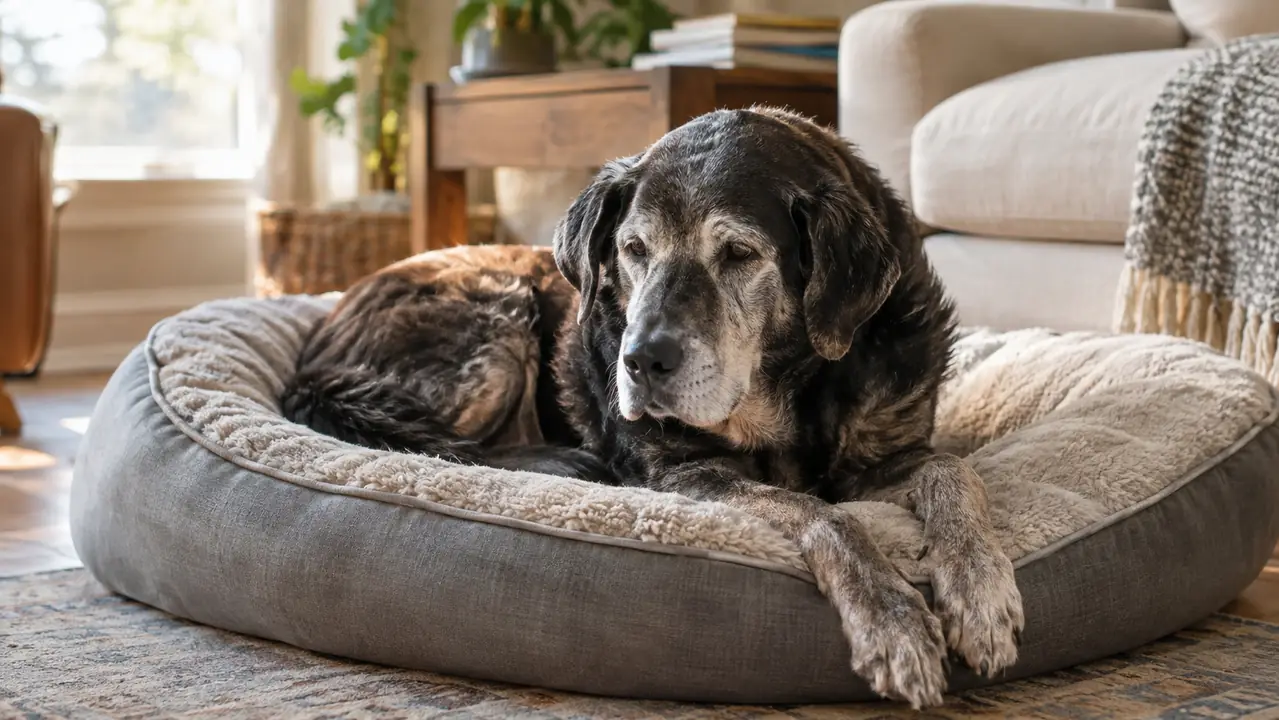
Biscuit started hesitating at the back steps before he started hesitating anywhere else. Labs are bred to jump in and out of trucks, so a dog that suddenly thinks twice about a six-inch drop will get your attention if you let it. Then came the moment I saw him brace his front legs before he climbed into the SUV, and the way he moved his back end slowly, like he was checking the joints before he committed. I spent twenty-four years as a veterinary technician, so I knew what I was looking at. Stiff hips. The kind that get worse overnight, especially when a dog has spent the night on a floor that gives him nothing to sink into. I ended up choosing the EHEYCIGA orthopedic bed for Biscuit, and the steps below are the same ones I used to get there.
A dog with stiff hips does not sleep the way a healthy dog sleeps. He shifts all night. He gets up more often, and every time he gets up, he is fighting his own joints to do it. A bed is not going to cure arthritis, and anyone who tells you otherwise is selling something. But a good bed can be the difference between a dog who wakes up stiff and a dog who wakes up stiff and sore from a night on tile. When I went looking for a bed for Biscuit, the EHEYCIGA orthopedic extra large bed is the one I kept coming back to, and I will use it as the example while I walk you through what to check before you buy any bed for a dog with stiff hips.
The extra large orthopedic bed I picked for Biscuit
The EHEYCIGA orthopedic dog bed has a waterproof cover, a washable top, and foam that supports a 74-pound dog instead of sinking under him. It is the bed in my living room right now.
Amazon Check Today's Price on Amazon →Step 1: Measure your dog before you measure the room
The biggest mistake I watched owners make at the clinic was buying the bed that looked right in the photo. Beds look huge in product shots. That same extra large bed that swallowed the model dog in the stock photo will be exactly the right size for an 80-pound dog that likes to stretch out. And a bed that is too small is worse than no bed at all for a dog with stiff hips, because it forces him to keep his hips flexed all night, which is the exact position that makes them stiffen up.
Measure your dog stretched out on his side, from the tip of his nose to the base of his tail. Add eight to ten inches for a dog that likes to stretch, and a little more for a dog that sprawls into a full starfish position. Biscuit is 74 pounds and measures about 34 inches when he is stretched out, which put us squarely in extra large territory. Do not guess. Grab a tape measure and check, because the difference between a large and an extra large is often only a few inches on the label but a whole night of comfort for your dog.
Then measure the floor space where the bed will live. An extra large bed is a serious piece of furniture. It will take up a corner of your living room, and it will not tuck under anything. If you do not have a spot that fits, you will end up moving the bed around every night to get it out of the way, and then your dog will stop trusting it as his place.
Step 2: Press on the foam before you trust the word 'orthopedic'
'Orthopedic' gets thrown around a lot in pet bedding. Some of it is marketing. I have seen so-called orthopedic beds that are nothing more than a slab of cheap polyurethane foam with a fleece cover, and any dog over 50 pounds will press straight through them to the floor in a month. Real orthopedic support means the foam is dense enough to distribute the dog's weight across the surface instead of letting his hip bones and elbows carry the load.
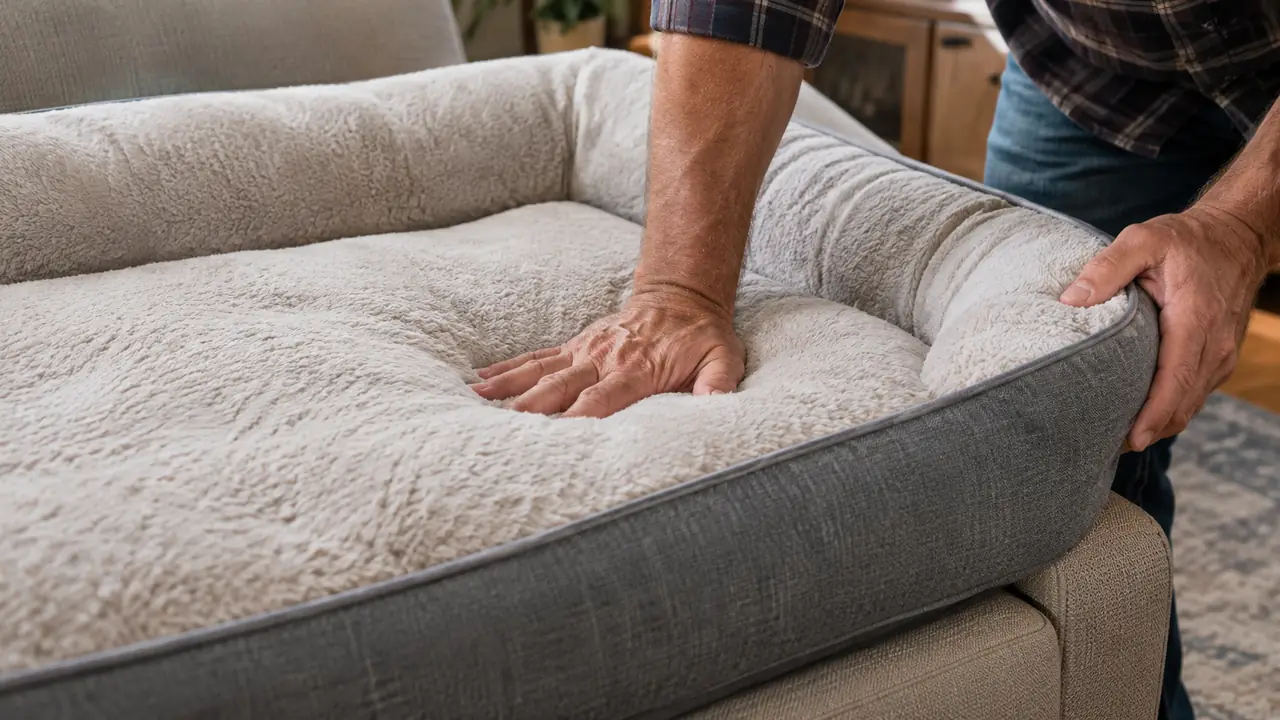
The test I use is simple. Press the flat of your hand into the foam with real pressure, the way a 74-pound dog's hip would press into it. A decent orthopedic foam resists the press and springs back slowly. A cheap foam compresses all the way down, right to the surface under your hand, and it stays compressed for a few seconds. If you can bottom it out with one hand, a heavy dog will bottom it out in a month and you will be back to square one, except the dog is sleeping on a 30-pound sponge that picked up his shape.
Thickness matters as much as density. A thin slab of dense foam is still a thin slab, and a heavy dog will feel the floor through it before the night is over. When I was comparing beds for Biscuit, I discounted anything that showed a single thin foam layer and looked for a base thick enough that a 74-pound dog could not bottom it out. The EHEYCIGA passed the palm test, and it has held its shape through months of daily use.
Step 3: Choose an entry your dog can actually manage
Here is where I see the second-biggest mistake. Owners buy a plush, high-sided bed because it looks like a cloud, and then their stiff-hip dog stands at the edge like it is a baby gate. If a dog hesitates at a six-inch drop-off to the yard, he is going to hesitate at a tall wall of bolster. The bed's job is to be easy to get into, not pretty. For a dog with stiff back hips, the entry height matters more than almost anything else.
Watch how your dog gets up from the floor. Does he use his front legs to haul his back end up? Most dogs with stiff hips do. That means he needs a low edge he can step over, not a high rim he has to climb. Some dogs also like to rest their heads on a raised side when they sleep, which is a real comfort for them. If that is your dog, look for a bed with a raised rim but a low, open entry on one side, so he gets the head support without the climb.
When I set up the EHEYCIGA for Biscuit, I watched how he approached it. He sniffed it, stepped on, turned around twice, and settled. A stiff dog will tell you fast whether a bed is easy to get into. You can watch for the same thing the first night, and you will learn more in five minutes than from any listing.
Step 4: Check the cover before you check out
A bed for an older dog is going to get dirty. That is not pessimism, it is math. Stiff hips can mean a dog who does not want to get up and go outside in time, and a dog who has accidents is not a bad dog, he is a dog whose joints are fighting him. Which means the cover is not a detail you can skip. It has to actually come off, it has to survive the washing machine, and it has to be waterproof enough to protect the foam below.
Look for a zipper that runs around the cover so you can actually pull it off without wrestling it. Look for a separate waterproof liner or a waterproof backing on the cover, because the foam is the expensive part and once urine reaches the foam, you are buying a new bed. And check whether the cover is machine washable or needs special handling. Somewhere out there is a bed labeled 'spot clean only,' and the dog with stiff hips will make that the worst purchase of your month.
The non-slip bottom is the detail people forget. My floors are tile and laminate, which is hard on a stiff dog even before you add a bed that slides when he steps on it. If the bottom of the bed skates across the floor, your dog will feel the shift under his feet and he will stop trusting the bed. He might stop using it entirely. When I picked the EHEYCIGA, I checked that the base would not slide on the laminate, because Biscuit does not need a bed that moves out from under him.
Step 5: Put the bed where your dog already wants to be
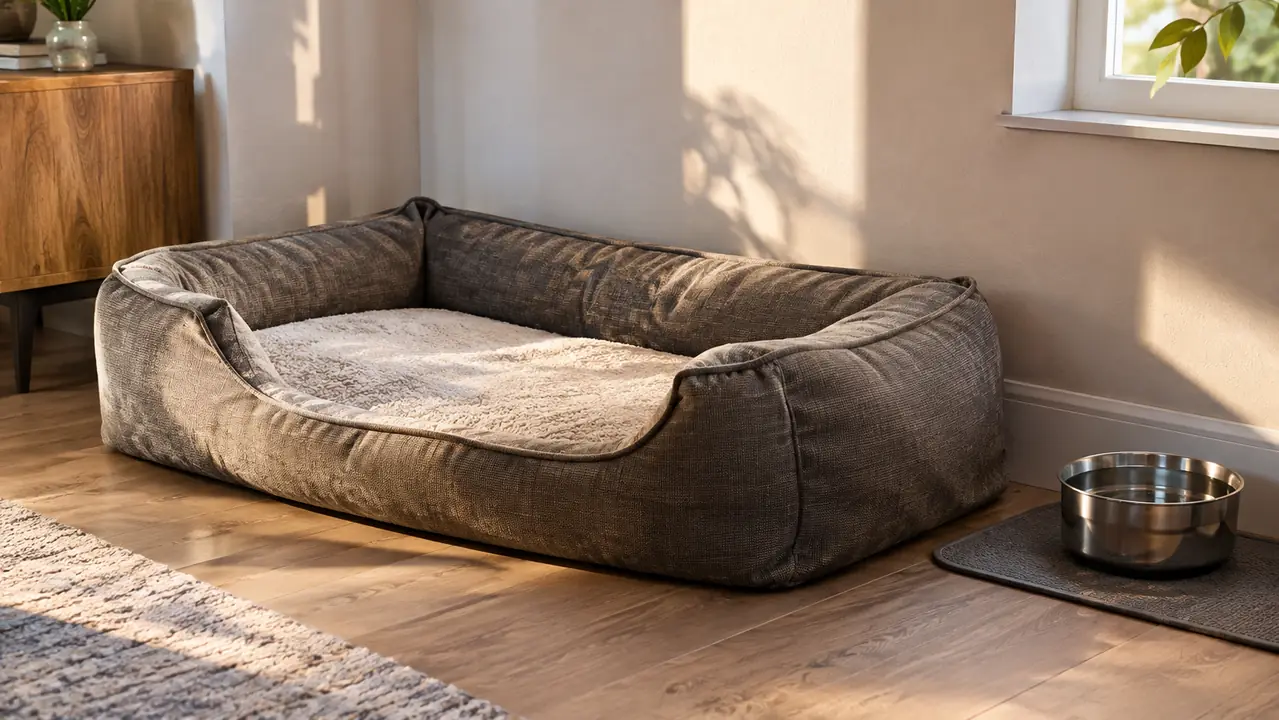
Location is half the battle. A dog with stiff hips runs cold, and a bed placed in a drafty hallway or against a cold wall will not get used no matter how good the foam is. Biscuit has his bed in the corner of the living room, near the heat register and away from the walking path, because that is where he already camped out on the floor. He moved into the bed within a day because it was in his spot and it was warmer than the tile.
If your dog sleeps in your bedroom, that is where the bed belongs, even if it is not where you pictured it. The dog's comfort wins, because sleep is when a stiff dog recovers the most. And if you are bringing the bed home for a dog who has never had one, give him time. Put an unwashed t-shirt that smells like you on top of it for the first few nights. The smell is what tells him it is safe. Do not stand over him waiting for him to approve. Go about your evening, and he will decide on his own.
One more thing about placement: give him a corner with a way out. A dog with stiff hips does not want to be in the middle of foot traffic, and he does not want to be crowded up against a wall with only one way out. A corner with the bed a few inches from the wall gives him a sense of shelter without trapping him. Watch him the first week. Where he chooses to sleep tells you everything about whether the spot is right.
What Else Helps
A bed is one piece of the puzzle, and it is worth doing the other pieces at the same time. Runners and rugs on bare floors make an enormous difference for a dog whose hips are stiff, because he does not have to grip with every step. I put runners down the hallway and by the back door, and Biscuit stopped walking like he was on ice. A low ramp or an extra step at the back porch can help with the drop he hesitates at, the same way a step helper can make getting into the SUV easier.
And the part I have to say plainly: keep the vet in the loop. I was a vet tech for twenty-four years, so I know how much the word 'arthritis' scares people. It is a manageable diagnosis. Your vet can talk to you about pain medication, joint supplements, and whether your dog's weight is making the stiffness worse. The bed helps him rest, and rest is real medicine. But if your dog is limping, crying, or suddenly cannot get up, that is a vet visit, not a shopping trip. The bed is not a substitute for your veterinarian's advice, and I would never suggest otherwise.
You cannot cure arthritis with foam. But you can keep a dog from fighting his own joints all night, and that counts for a lot.
The bed Biscuit uses every single night
The EHEYCIGA orthopedic extra large bed is waterproof, washable, and built for a dog Biscuit's size. It is the bed I would hand to a client at the clinic, and the one I bought for my own living room.
Amazon Check Today's Price on Amazon →