

I spent 24 years as a veterinary technician, and for most of that time I had a quiet opinion about joint supplements: they were the thing we sold at the front desk while we waited for the real medicine to do its work. I handed out plenty of bottles. I read the ingredient labels. I nodded along when clients asked if they were worth it. And honestly, I was never sure. Then my own dog, Biscuit, an 11-year-old yellow Lab mix, started hesitating at the back steps. Three steps. He would stand at the bottom, look up, and wait. That is when I decided to find out what I actually believed about Cosequin, the supplement made by Nutramax Laboratories that I had recommended to more owners than I can count.
This is not a review from someone who tested a product for a week and wrote down the good parts. This is a review from someone who watched a stiff old dog for six months, kept notes, and had to admit when the evidence surprised her. I am not a veterinarian and nothing here is a diagnosis. If your dog is limping, in pain, or suddenly struggling to get up, please see your own vet first. But if you have a senior dog who is slowing down, and you are trying to decide whether a joint supplement is worth the money, I will tell you exactly what I found, including the parts the marketing does not mention.
The Quick Verdict
Cosequin is a solid, well-studied joint supplement that helped my stiff senior dog get up the back steps again. It is not a cure, it takes weeks to show anything, and some dogs will not respond at all. But for a dog with mild age-related stiffness, it is the first thing I would try, and I say that after years of being skeptical.
Amazon Check Today's Price →The joint supplement I finally trusted enough to give my own dog
After six months of daily use, Cosequin is the supplement I recommend to friends with stiff senior dogs. It will not fix a torn ligament or cure arthritis, but for mild age-related stiffness it is a reasonable place to start.
Amazon Check Today's Price on Amazon →How I Used It
Biscuit is 74 pounds, which puts him in the large dog range for Cosequin. The directions say to give two chewable tablets a day for the first four to six weeks, then drop to one tablet a day for maintenance. I followed that exactly. I gave the loading dose for six weeks, then moved to the maintenance dose, and I kept a small notebook on the kitchen counter where I wrote down how he moved every morning.
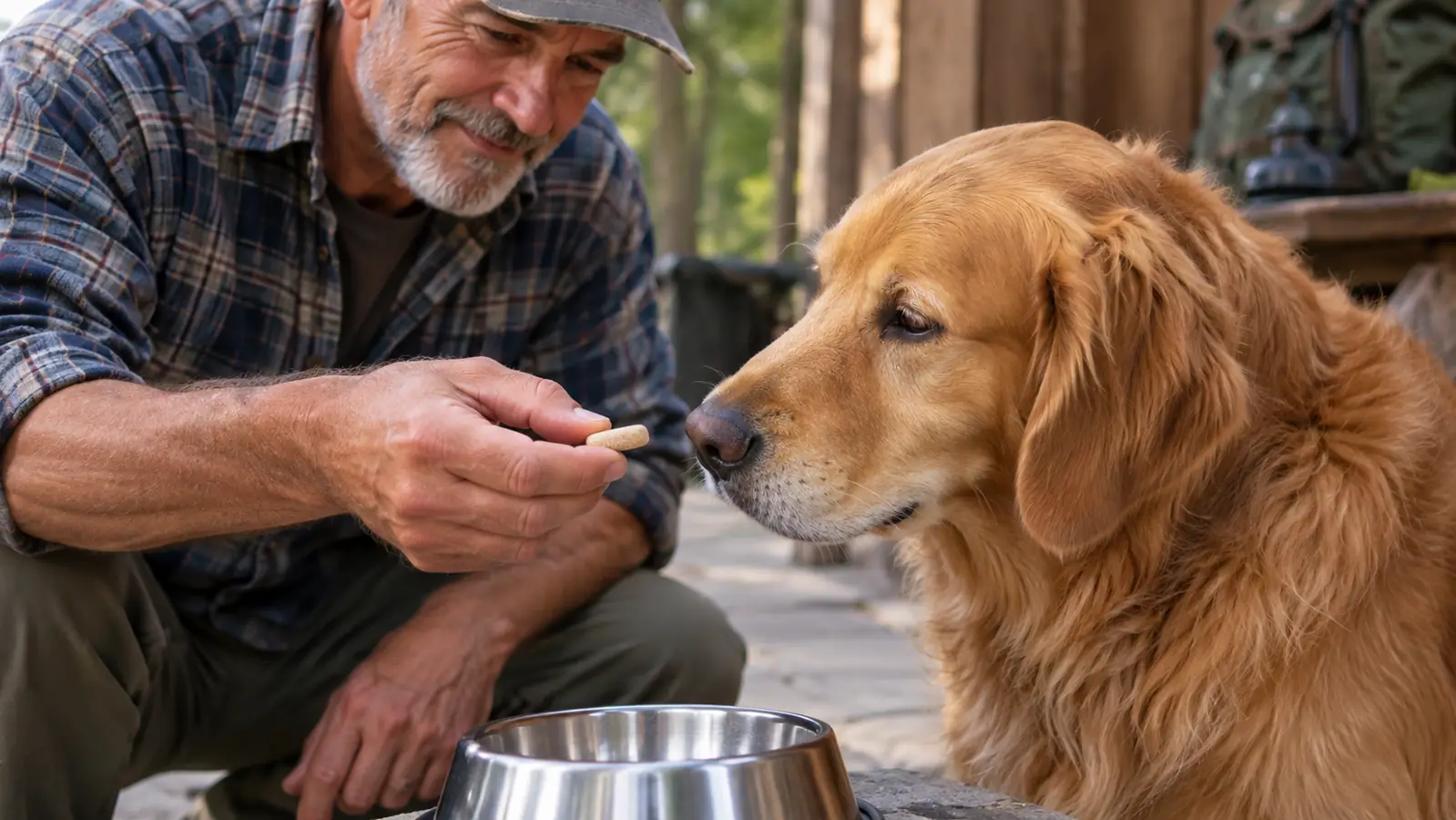
I want to be clear about what I was looking for. I was not looking for a magic fix. I was looking for small things: whether he still hesitated at the back steps, whether he needed a running start to jump into the SUV, whether he was slower to stand up after a long nap. I also watched for the things nobody wants to talk about, like whether the supplement upset his stomach or made him not want to eat. I gave the tablets with his breakfast, hidden in a small piece of plain chicken, and I never had a single refusal.
One thing that surprised me: the chewable tablets have a smell. It is not unpleasant, but it is noticeable, and it is clearly designed to make the tablet appealing to a dog. Biscuit treated it like a treat. If your dog is a picky eater, you may need to hide the tablet in food, because the texture is a little chalky when you break it in half.
Getting the tablet into Biscuit turned out to be the easy part, which I did not expect. Labs will eat almost anything, but some older dogs get picky, and a supplement only works if it goes down every single day. I gave it with his breakfast for the first two weeks, broken in half and pressed into a spoonful of his wet food. By week three I stopped bothering with the disguise and just handed it to him as a treat after his morning walk around the yard. He started sitting by the counter where I keep the bottle, which tells you how he feels about the taste. If your dog is fussier than mine, a little plain pumpkin or a bit of his regular canned food usually covers it.
What Nobody Tells You About Joint Supplements
Here is the part that the product page will not put in big letters: joint supplements do not work for every dog, and they do not work quickly. In the clinic, I saw dogs who seemed brighter within two weeks and dogs who showed no change after three months. The research on glucosamine and chondroitin is genuinely mixed, and anyone who tells you otherwise is selling something. What the research does support is that these ingredients are safe for most dogs, and that some dogs with mild osteoarthritis do show measurable improvement. That is a much more honest claim than 'relieves joint pain,' and it is the claim I can make about Biscuit.
The second thing nobody tells you is that the loading dose matters. Cosequin's own instructions say to double the dose for the first four to six weeks, and I think a lot of owners skip this because they do not read the label. They give one tablet a day, see no change in a month, and conclude the supplement does not work. I followed the loading dose exactly, and I believe it made a difference. If you start Cosequin, follow the label. The company has a reason for those instructions.
The third thing is the one I feel most strongly about: a supplement is not a painkiller. If your dog is genuinely in pain, if they are whimpering, refusing to put weight on a leg, or crying when they stand up, a joint supplement is not the answer. That dog needs a veterinarian, and probably needs real pain management. Cosequin is for the slow, creaky, getting-up-stiffly dog, not the dog who is suffering. I cannot say this loudly enough.
There is one more thing I would add to that list, and it is about patience with yourself. When you are watching a dog you love struggle at the steps every morning, a few weeks feels like a long time. I caught myself checking Biscuit at the back door every day for the first ten days, looking for a change that was never going to show up that fast. At the clinic we used to tell owners to pick one specific thing to watch, write it down once a week, and stop staring at it in between. For me that was how many tries it took him to get up off the kitchen floor after a nap. Writing it down once a week kept me honest, and it kept me from quitting early.
After six weeks on the loading dose, Biscuit stopped standing at the bottom of the back steps. He still took them slowly, but he took them. That is the honest version of what this supplement did for us.
The Ingredients, Explained the Way I Explain Them to Friends
Cosequin's main ingredients are glucosamine hydrochloride, chondroitin sulfate, and MSM. I will translate that into what it actually means for a dog's body. Glucosamine is a building block for cartilage, the smooth tissue that lets bones glide past each other in a joint. Chondroitin is a component of cartilage that helps it hold water, which keeps it springy. MSM is a sulfur compound that is often added for its anti-inflammatory effects. The idea is that by giving the body more of these building blocks, you support the joint's ability to maintain itself. It is a reasonable idea, and it is the same idea behind most joint supplements on the market.
What makes Cosequin different from the generic bottles at the big box store is mostly quality control. Nutramax Laboratories is one of the few supplement makers that runs clinical trials on its own products, and they publish the results. That matters to me, because the supplement industry is not regulated the way prescription drugs are. A company can put 'glucosamine' on a label and have very little of it actually make it into the chew. Nutramax Laboratories tests its products for purity and potency, and that is worth paying for, in my opinion.
I also appreciate that the company is transparent about the amount of each ingredient in the chew. You can look at the label and see exactly how much glucosamine and chondroitin are in each tablet. That sounds like it should be standard, but it is not. Many supplements list a 'proprietary blend' and never tell you the actual amounts. Cosequin does not do that, and for a former vet tech, that transparency is a big part of the value.
A word about price per day, because people ask me this more than anything else. A large bottle of Cosequin looks expensive on the shelf, but the number that matters is what one dog costs you each day once the loading period is over and you drop to the maintenance amount. For a 74 pound dog like Biscuit, the big bottle lasts a good while after that first stretch. I compare it to the cheap tubs at the feed store that need four or five chews a day to reach a reasonable amount of glucosamine, and the gap closes quickly. I would rather pay for a product with a long track record and clear labeling than save a little on something I cannot verify.

The Six-Month Results, the Honest Version
I kept notes for six months, and here is what actually happened. In the first two weeks, nothing. I wrote 'no change' in the notebook more than once. At around week four, I noticed Biscuit was getting up from his bed a little faster in the morning. It was not dramatic. It was the difference between standing up in one motion and standing up in two. By week six, he stopped pausing at the bottom of the back steps. He still took them one at a time, but he did not stand there waiting. That was the moment I started to believe.
The car is a different story. Biscuit still needs a boost to get into the SUV, and Cosequin did not change that. His hips are not going to be the hips of a two-year-old, and no supplement is going to make them that. I also cannot tell you that he is pain-free, because I cannot ask him. What I can tell you is that he is moving more easily, he is more willing to go for walks, and he has not had a single day of digestive upset from the supplement.
I want to be honest about the limits of my little experiment. It is one dog, and I was not running a controlled trial. Dogs get better and worse on their own, and it is possible that some of the improvement was just the warmer weather or the fact that I was paying more attention. But I have seen enough dogs in my career to know that the change in Biscuit was real, and it was the kind of change I used to see in clients' dogs when the owners actually stuck with the supplement for two months.
I also want to say plainly what I did alongside the supplement, because none of it happened in isolation. Biscuit kept his two short walks a day, I kept him at a steady weight by measuring his food instead of guessing, and he sleeps on a thick orthopedic bed instead of the bare floor. Any of those things helps a stiff dog on its own. So when I say his mornings got easier, I cannot hand all of the credit to one bottle, and I would be suspicious of anyone who tells you they can. What I can tell you is that Cosequin was the piece I added, and the improvement followed it closely enough that I am not willing to stop giving it.
What I Liked
- Clear labeling of glucosamine, chondroitin and MSM per tablet
- Chewable tablet Biscuit takes as a treat, no hiding needed after the first weeks
- Long track record and widely recommended by veterinary clinics
- Large bottle keeps the daily cost reasonable once the loading period ends
- Mornings and back steps got noticeably easier over a few months
Where It Falls Short
- Takes four to six weeks before you see anything, which tests your patience
- The tablets have a smell some owners will not like
- Not a pain reliever, so a dog in real pain still needs the vet
- Results vary from dog to dog and are hard to measure precisely
Who This Is For
Cosequin is for the owner of a senior dog who is slowing down in the ordinary way. The dog who is a little stiff in the morning, who hesitates before jumping, who takes the stairs more carefully than they used to. If that sounds like your dog, and your vet has confirmed that the stiffness is age-related arthritis rather than an injury, Cosequin is a reasonable thing to try. It is safe for most dogs, it is easy to give, and the chewable form means you will not be fighting your dog twice a day. Give it a full eight weeks before you judge it, and follow the loading dose on the label.
Who Should Skip It
Skip Cosequin if your dog is in obvious pain. If they are limping, crying, refusing to eat, or unable to get comfortable, do not reach for a supplement. Go to your veterinarian. Skip it if your dog has a known allergy to shellfish, because glucosamine is often derived from shellfish. And skip it if you are not willing to give it a real chance. A supplement you give for ten days and then abandon is a waste of money. If you want a quick fix, this is not it. If you want to support your dog's joints over the long term, and you have a patient, realistic mindset, it is worth trying.
Give it eight weeks before you judge it
Cosequin is not a quick fix, and I would not trust any supplement that promised to be one. But for a stiff senior dog, it is the supplement I reached for, and the one I would buy again.
Amazon Check Today's Price on Amazon →