
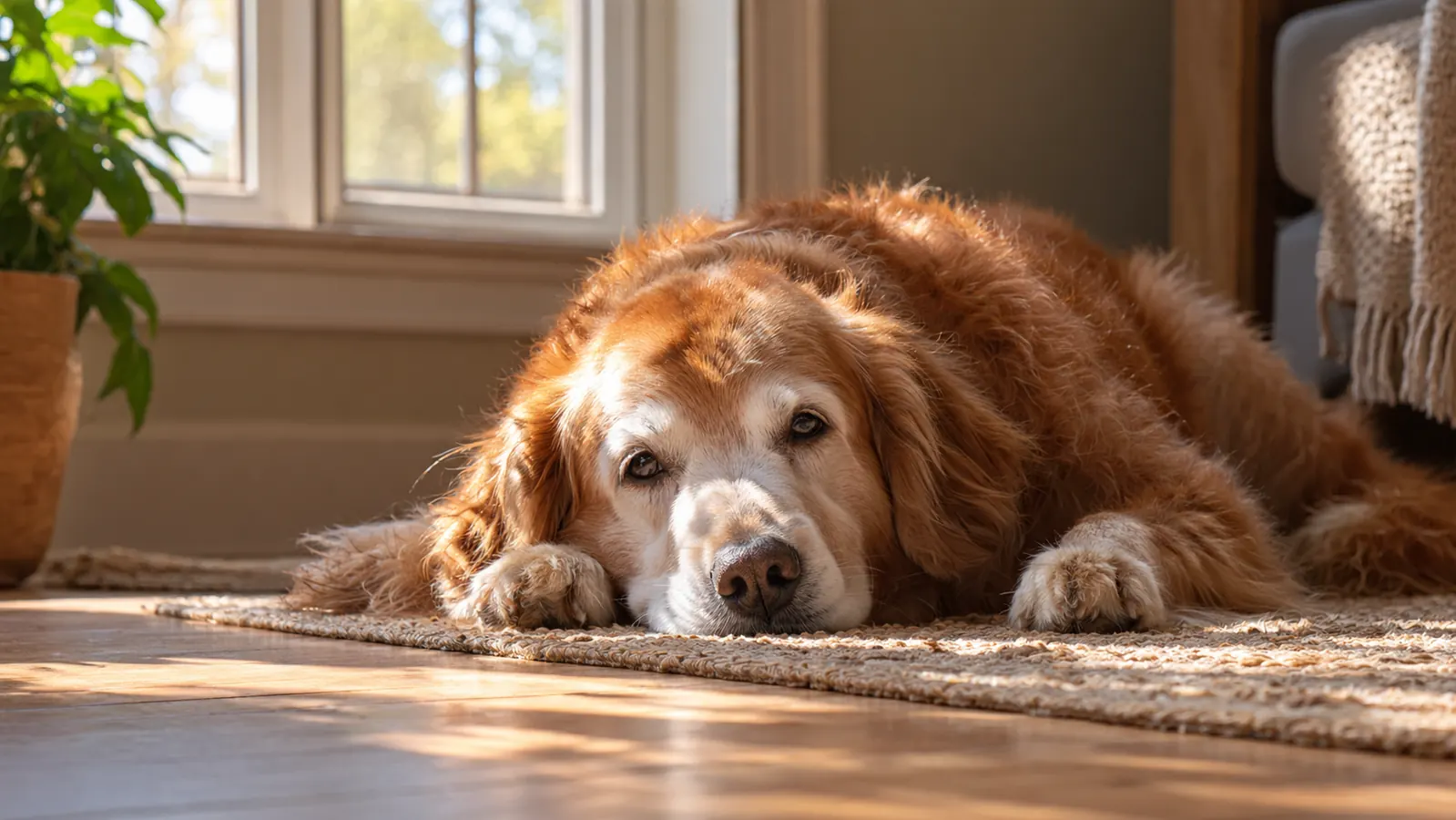
The first sign was Biscuit pausing at the back steps. Eleven years old, about 74 pounds, a yellow Lab mix who had never once hesitated at those three steps. Then came the slow get-up from his bed, the stiff walk to the water bowl, the little grunt when he finally stood. It was worst in the mornings, which is typical for a dog with creaky hips. I spent 24 years as a veterinary technician, so I knew what was happening in his joints. I also knew I wanted to try something at home before I made a vet appointment, and I wanted a plan, not just a supplement.
That plan is what this guide is about. These are the five steps I settled on for easing Biscuit's stiff mornings, with Cosequin from Nutramax Laboratories as the daily foundation. It is not a cure for arthritis, and it does not replace a veterinarian's advice. If your dog is limping, yelping, or suddenly unable to get up, skip this guide and call your vet. But if your dog is simply slower to rise, a little stiff after naps, and otherwise eating and acting normally, this routine is a good place to start.
Start the day with Cosequin, the joint supplement I give Biscuit every morning
One chewable tablet a day is the foundation of the routine below. Cosequin is made by Nutramax Laboratories and has been around for decades, which is why it is the one I trusted with my own dog.
Amazon Check Today's Price on Amazon →Step 1: Give Cosequin with the morning meal, every day, at the same time
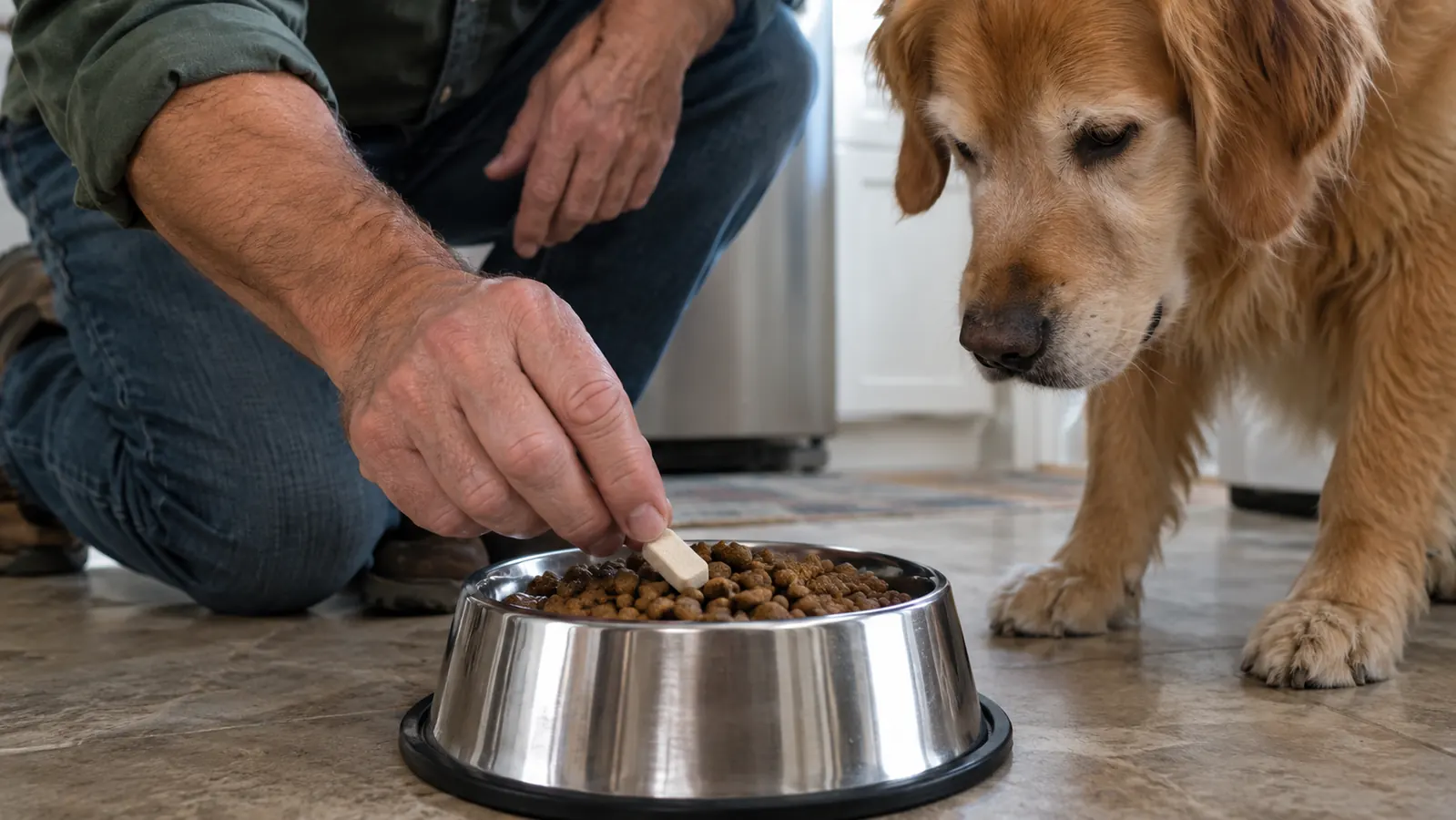
Consistency matters more than timing, but I found mornings easiest to remember. I give Biscuit one chewable Cosequin tablet with his breakfast. The tablet goes on top of his kibble, and he eats it first because it smells like a treat. On days he is less interested in food, I break the tablet in half and tuck both pieces into a spoonful of plain canned pumpkin or a little warm water mixed into his kibble. The goal is to get the full dose into him, not to fight about it.
Cosequin contains glucosamine hydrochloride and chondroitin sulfate, which are building blocks for cartilage, plus MSM for extra joint support. These are not pain relievers. They do not mask a problem the way an anti-inflammatory can. Instead, they give the body material to maintain and repair joint cartilage over time. That is why it is called a joint supplement and why it needs weeks to show its effect. The directions on the bottle say to give a larger amount for the first four to six weeks, then drop to the maintenance dose. That loading phase matters. Biscuit stayed on the higher amount for the full six weeks before I moved him to maintenance.
If you miss a day here and there, do not double up the next day. Just resume the normal schedule. I keep the bottle on the kitchen counter next to the coffee maker, so I literally cannot pour my coffee without seeing it. That small habit is what turned Cosequin from a thing I meant to give into a thing I actually gave every single day.
Step 2: Give him a gentle stretch before he stands
The worst part of a stiff morning is the first stand. Biscuit would lie there, front legs braced, back legs slow to unfold, and I could see him deciding whether it was worth the effort. I learned to help him before he even tried. I kneel beside him, say his name softly so he knows I am there, and run my hands along his back and hind legs for a few seconds. Nothing deep, just light contact to let his muscles wake up. Then I gently extend each back leg, one at a time, only as far as he allows. If he pulls away, I stop. The rule is: no forcing, no stretching a cold muscle, no pulling a leg that resists.
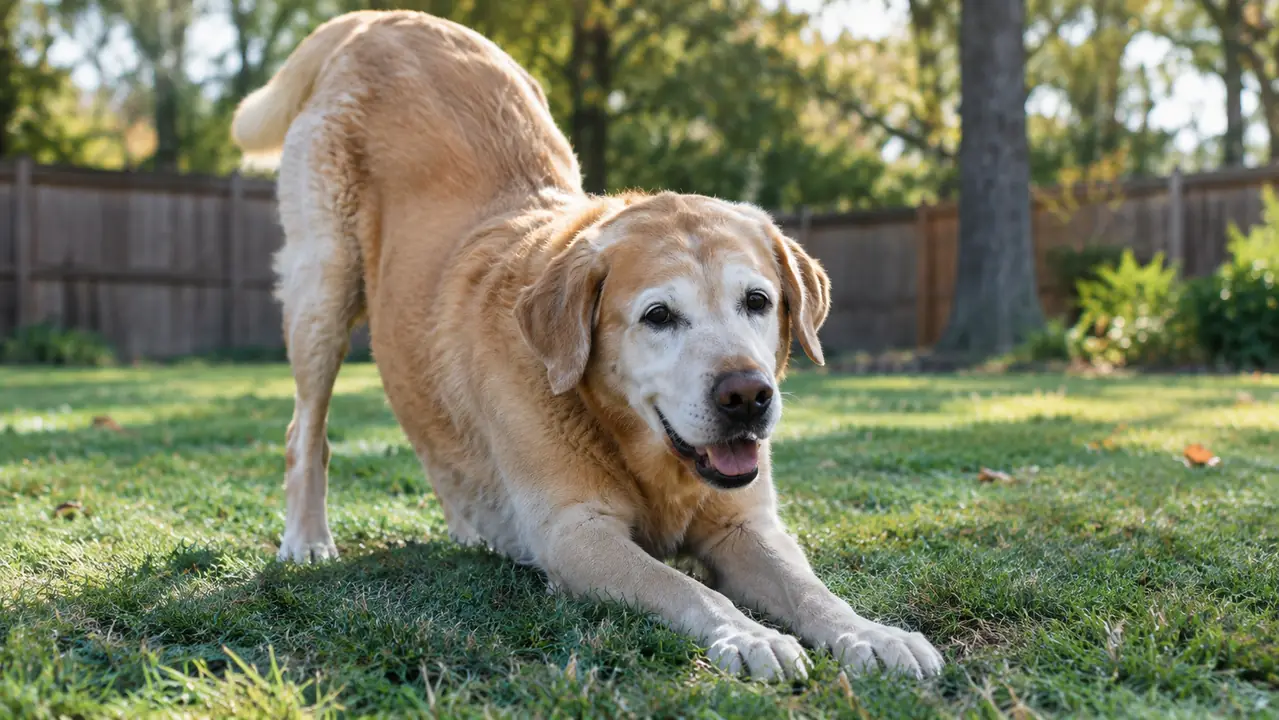
The goal is not a big range of motion. It is a signal to his body that it is time to move, delivered slowly and gently. I do this for maybe ninety seconds. Then I sit back and let him stand on his own schedule. Some mornings he pops right up. Other mornings he takes a few seconds, stretches his front legs out in a play bow, and then stands. Either is fine. The stretch before standing seems to make the first few steps steadier, and it costs nothing but a little patience.
A note on technique: I learned this from watching the rehabilitation specialist who came to our clinic. She called it passive range of motion, and she was clear that it should never hurt. If your dog tenses up, flinches, or growls, stop and talk to your vet. Some dogs do not like being handled around the hips, and that can be a sign of real pain. Stretching is a comfort measure, not a treatment, and it should always feel like a good thing to your dog.
Step 3: Warm him up with a short, slow walk before he faces the steps
For a long time, the hardest moment of Biscuit's day was those three back steps down to the yard. Stiff hips make going downhill harder than going up, because the hind legs have to lower the body with control. So I changed the order of the morning. Instead of letting him out the back door first thing, I take him out the front door, on a leash, for a slow walk around the front yard and down the driveway. Five minutes, sometimes ten. We are not exercising. We are warming up.
This is the step that made the biggest visible difference for Biscuit. After the walk, he takes those back steps like he used to, one confident step at a time, no pause at the top. The joints are not necessarily more comfortable in that short time, but the muscles around them are warmer and more ready to work. Warm muscles carry some of the load that stiff joints cannot. That is the whole idea, and it works for dogs the same way it works for people.
Keep the walk slow and flat. No hills, no jogging, no chasing a ball. The morning walk is a warm-up, not exercise. I let Biscuit set the pace, which is usually a slow, sniffy amble. The sniffing is good for him too. Mental stimulation in the morning seems to put him in a better mood, and a relaxed dog moves more easily than an anxious one. If your dog pulls or seems eager, that is fine, but keep it gentle. Save the real exercise for later in the day, after he is fully loose.
Step 4: Put down traction where he needs it
Our house has tile and laminate floors, and I watched Biscuit's back feet slide out from under him more times than I want to count. A dog with stiff hips relies on his hind legs for pushing off, and if those legs cannot get traction, he looks wobbly even when his joints are not the whole problem. The fix is cheap and immediate: runners and rugs on the paths he walks most. I put a long runner in the hallway, a rug at the foot of the bed, and a rubber-backed mat at the back door. His feet grip, and suddenly he stands and turns with more confidence.
You do not need to carpet the whole house. Just cover the routes he uses every day: from his bed to the water bowl, from the living room to the back door, and at the top and bottom of any steps. Make sure the rugs have non-slip backing or use a rug pad underneath. A rug that slides on a hard floor is worse than no rug at all, because the dog can trip on the edge. Test each rug by pushing it with your foot. If it moves, it needs a pad.
Traction also matters outside. Biscuit is fine on grass, but the concrete path along the side of the house is slippery when the morning dew is on it. I keep him on the grass as much as possible in the early morning. For dogs who live in houses with stairs, a ramp or a second set of stairs with wider, shallower steps can help a lot, but that is a bigger project. Start with rugs and see how much of the problem they solve. For Biscuit, the rugs solved more than I expected.
Step 5: Keep him moving all day, but keep the load off his hips
The opposite of a stiff morning is not a lazy day. It is a day with steady, moderate movement. When Biscuit lies in the same position for hours, he stiffens up again and the cycle repeats. So I build little movement breaks into his day. A short walk after lunch, a few minutes of gentle play in the yard, a slow lap around the block in the evening. Nothing that makes him pant hard, nothing that involves jumping. Just enough movement to keep the joints from locking up.
I also stopped letting him jump into the car. Our SUV has a high cargo floor, and watching him gather himself and leap was hard to watch. Now I lift his back end onto the seat, or I use a ramp I keep in the garage. The same goes for the couch. He is not allowed to jump off the furniture anymore. I put a low ottoman next to the couch so he can step down in two stages. Protecting the hips from repeated impact is part of the plan, and it matters as much as the supplement.
And I watch his weight. Biscuit is 74 pounds, which is on the higher side for his frame, and every extra pound is extra load on those back hips. He is on a measured amount of food, and treats come out of his daily allowance. Weight management is the single most effective thing any owner can do for a stiff older dog, and it is completely free. If you are not sure whether your dog is at a healthy weight, your vet can tell you in about thirty seconds.
What Else Helps
Cosequin is the foundation of Biscuit's morning routine, but it is not the only thing that helps. A heated bed in the winter keeps his joints from getting cold overnight, and I have noticed he gets up more easily from a warm bed than from the bare floor. Orthopedic beds with memory foam give his hips something soft to sink into, and I put one in the living room and one in the bedroom so he never has to choose between comfort and being near us. I also add a teaspoon of fish oil to his dinner for the omega-3 fatty acids, which support joint health. And when the morning stiffness seems worse than usual, I call the vet. I do not guess, and I do not wait. Some days need more than a supplement, and that is exactly what veterinarians are for.
After six weeks on Cosequin, with the stretches and the morning walk added in, Biscuit stopped hesitating at the back steps. He still has stiff days. He just has fewer of them.
Give your dog the same daily foundation I give Biscuit
Cosequin from Nutramax Laboratories is the supplement I start every single morning with. It will not fix an injury and it will not replace your vet, but it is a solid, well-studied daily foundation for a stiff older dog.
Amazon Check Today's Price on Amazon →