
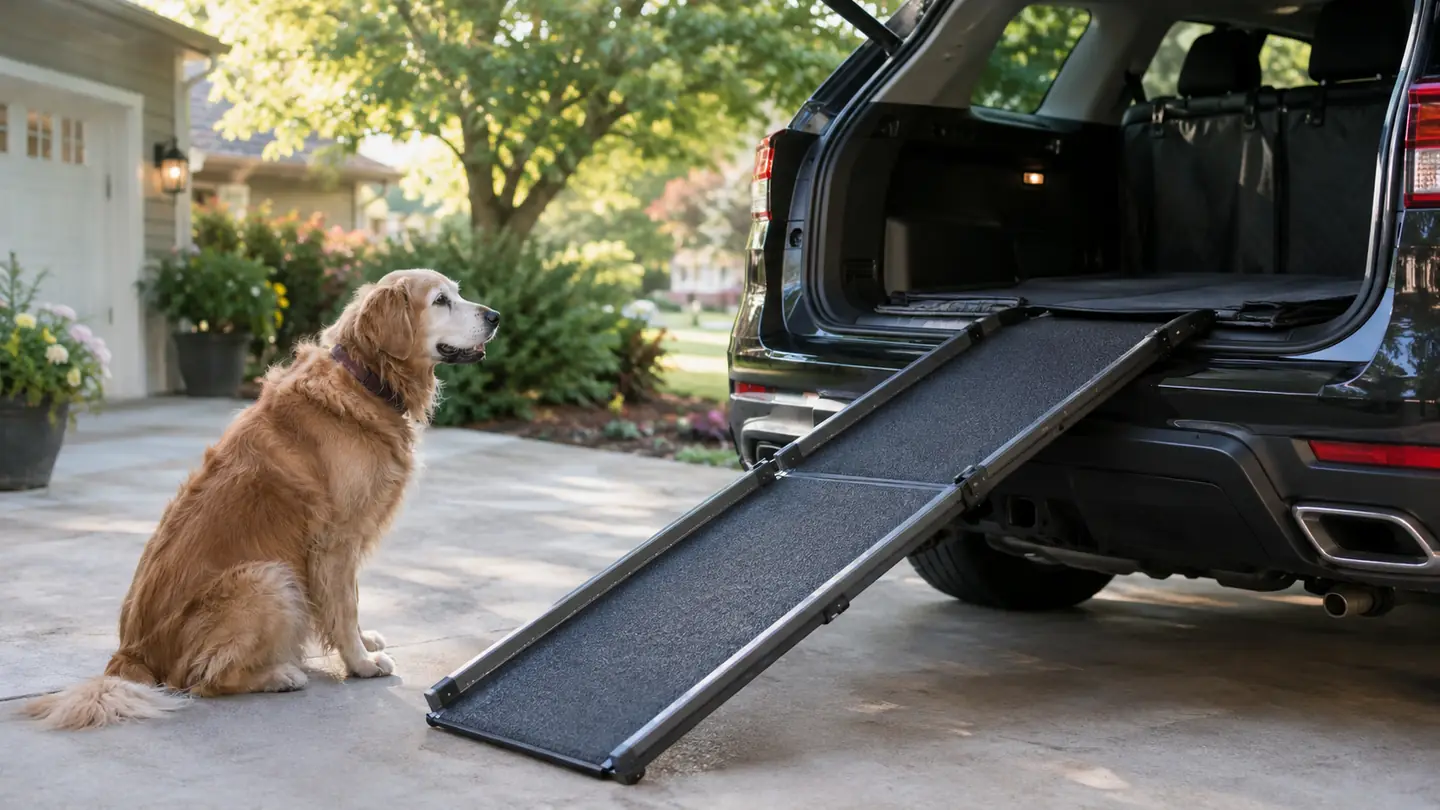
The first time Biscuit hesitated at the open tailgate, I thought he was just being stubborn. He is 11, a yellow Lab mix, about 74 pounds, and he has always jumped into the SUV like it was nothing. Then one morning he stood there with his front paws on the bumper, looked back at me, and let out a small grunt. That grunt is the sound of a dog who wants to get in the car and knows his back hips are not going to cooperate. I spent 24 years as a veterinary technician, so I knew exactly what was happening. Stiff hips, weak rear legs, and a cargo floor that sits higher than his shoulder. Lifting him was not the answer. At 74 pounds, he is too heavy for me to lift safely, and lifting a dog with joint pain by the belly can make things worse. What worked was a folding ramp from PetSafe and a five-step routine that I now use every single time.
This guide is the routine I wish someone had handed me before I spent a week trying to coax him up with treats and a towel sling. It covers the ramp I use, how to introduce it to a dog who has never seen one, how to position the SUV, how to walk beside him so he feels supported, and what to do when he plants his feet and refuses. If your dog is hesitating at the car door, this is the process that got us from grunts to a calm, steady climb in about four days.
The ramp that ended our morning standoff
The PetSafe Happy Ride Folding Dog Ramp is the one I keep in the back of the SUV. It folds flat, has a non-slip surface, and gives Biscuit a wide, stable path into the cargo area. Check today's price on Amazon before you start the routine.
Amazon Check Today's Price on Amazon →Step 1: Pick a ramp that gives your dog a wide, stable path
Before you teach your dog anything, you need a ramp that does not wobble, slide, or flex under his weight. The PetSafe Happy Ride Folding Dog Ramp is the one I settled on after trying a narrower ramp that Biscuit refused to set a paw on. It is wide enough for him to walk without straddling the edges, and the surface gives his paws something to grip even when the driveway is damp. The ramp folds in half for storage, which matters because it lives in the back of the SUV between trips.
Set the ramp up on flat ground before you bring the dog anywhere near it. Lock the legs, press down on the center with your own weight, and make sure it does not rock. A ramp that moves under a dog's feet is a ramp that teaches him to be afraid of ramps. If the surface feels slick to your shoes, it will feel slick to his pads, so add a rubber mat or a towel over the ramp until you can order a better one.
One more thing: measure the height. The ramp needs to reach the cargo floor at an angle your dog can manage. If the angle is too steep, even a confident dog will balk. The PetSafe ramp adjusts to the height of the SUV, and I set it so the slope is gentle enough that Biscuit can walk up with his head level instead of looking up the whole way.
Step 2: Let your dog inspect the ramp on the ground first
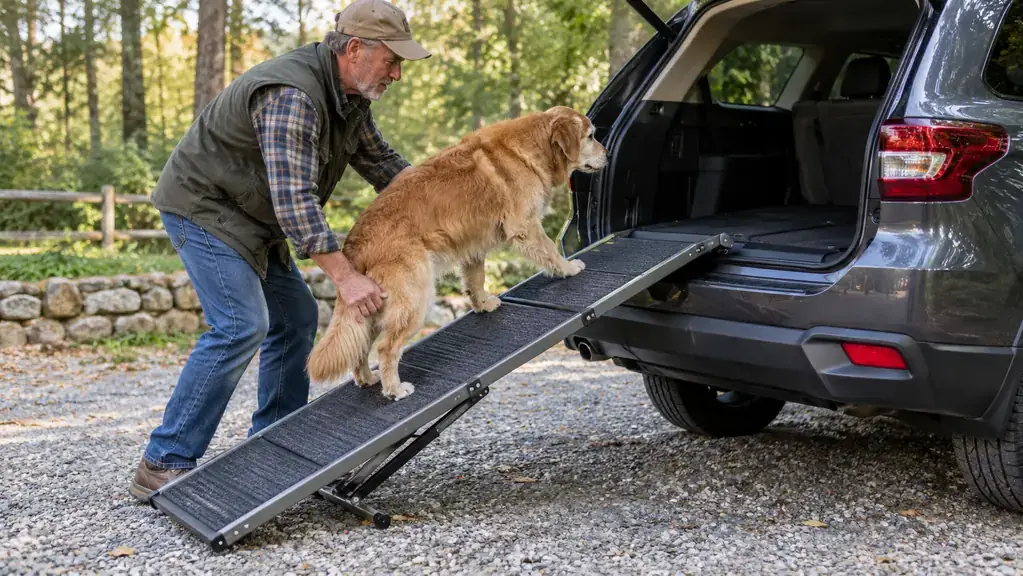
Do not put the ramp against the car on day one. Put it flat on the ground in the yard or the garage and let your dog sniff it, walk over it, and decide it is not a threat. I left the PetSafe ramp flat on the patio for an afternoon. Biscuit walked over it twice, stepped off, and came back for a third pass when he realized it was not going to move. That is the whole goal of this step: the ramp becomes boring.
Once he is walking over it on the ground without a second thought, prop one end on a low step or a stack of pavers, maybe six inches high. Walk him over it a few times with a treat at the far end. Then raise it to the height of a curb. Each time, keep the angle gentle and keep your body low so you are not towering over him. You are teaching his back legs that the ramp will hold his weight at an angle, not just flat.
This is also the step where you learn whether the ramp is too steep or too slick before the car is involved. If he hesitates at the curb height, the ramp is not the problem. The angle is. Adjust it, add traction, or pick a longer ramp. Do not push him. A dog who is forced up a ramp he does not trust will remember it the next time.
Step 3: Position the SUV and the ramp so the climb is as straight as possible
Park on level ground. This matters more than people think. If the SUV is tilted even slightly, the ramp sits at an awkward angle and the dog has to correct his footing the whole way up. I park in the driveway with the nose pointing downhill just a touch, which makes the cargo floor sit a little lower and gives Biscuit a slightly shorter climb.
Open the tailgate all the way and hook the ramp's lip over the edge of the cargo floor. The PetSafe ramp has a lip that locks over the bumper, so it cannot slide backward while he is on it. Give the ramp a firm push down with your hand to confirm it is seated before you call the dog over. Then stand beside the ramp, not behind him and not in front of him. You want to be at his shoulder so he can see you out of the corner of his eye the whole way up.
If your dog is small enough to carry in an emergency, keep that as a backup. But for a 74-pound dog with stiff hips, the goal is to make the ramp the easiest option, not the only option. I stopped lifting Biscuit entirely once the ramp was in place. Repeated lifting by the belly or the chest puts pressure on joints that are already sore, and a dog who is lifted badly can learn to fear the car altogether.
Step 4: Walk beside him with a treat at nose level, not above his head
The biggest mistake I see owners make is holding the treat above the dog's head to lure him up. That makes the dog look up, which shifts his weight backward, which is exactly the wrong direction for a dog with weak rear legs. Hold the treat at his nose level, just in front of his chest, so he steps forward and up naturally. I use small pieces of boiled chicken for this, one piece at a time, and I do not give him the treat until all four paws are on the cargo floor.
Walk beside him on the side of his weaker hip. For Biscuit, that is his right side. Keep your hand light on his collar or his chest, not pushing, just there. The point is not to pull him up. The point is to let him know you are there if he stumbles. Dogs read our posture, and a calm, quiet walk beside the ramp tells him this is a normal thing we do together.
If he stops halfway, do not yank the treat forward and do not push his rear. Stop with him. Let him stand on the ramp for a few seconds. Say nothing. When he takes a step, move the treat forward again. The first time Biscuit did this, he stood on the ramp for a full twenty seconds, looked at the cargo floor, looked at me, and then walked the rest of the way like he had decided it was fine. That pause was him checking that the ramp was stable. It was. He has not paused since.
Step 5: Make the cargo area a place he wants to arrive
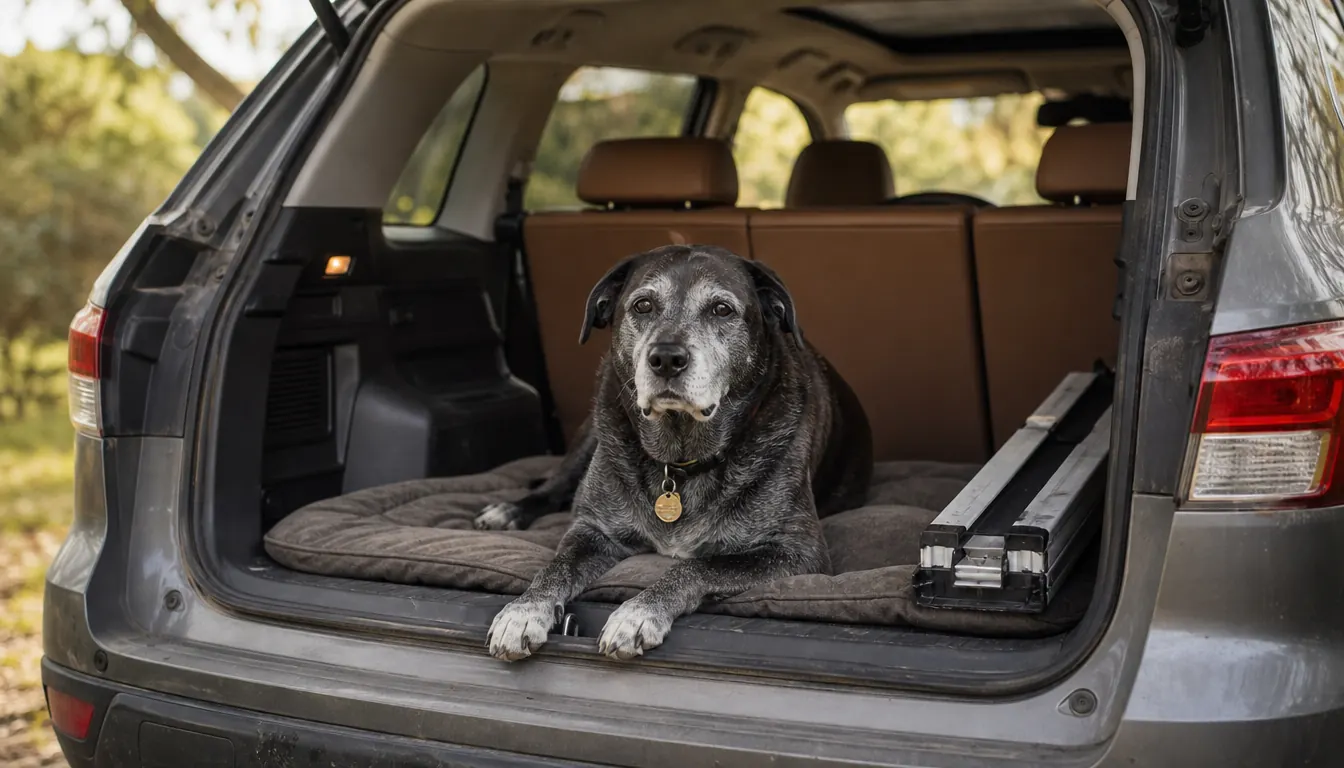
The climb is only half the battle. If the back of the SUV is a bare, slippery plastic floor, your dog will get to the top and immediately want to come back down. I put a rubber mat down first, then a padded bed with a non-slip bottom. Biscuit now walks up the ramp and turns around and lies down before I even close the tailgate. That is the behavior you are looking for: the ramp becomes the doorway to a comfortable spot, not a scary ledge.
Keep a treat jar in the car so the reward is always there. I keep a small container of biscuits in the door pocket, and Biscuit gets one every time he gets in without hesitation. The routine is the same every single time: ramp down, lip seated, walk beside him, treat at nose level, reward at the top. Dogs do better with repetition than with variety, and a senior dog with stiff hips does best when the routine never changes.
If your dog still refuses after two weeks of this routine, do not assume he is being difficult. Have your veterinarian check his hips, knees, and spine. Pain is the most common reason a dog stops using a ramp, and the ramp cannot fix pain. Biscuit's stiffness is managed with guidance from our vet, and the ramp is part of that plan, not a replacement for it.
What Else Helps
A ramp is the biggest piece, but it works better alongside a few other things. A towel sling under the belly can give a dog a little support on the way up without you having to lift his full weight. I keep one folded in the back of the SUV for days when Biscuit is stiffer than usual. A non-slip mat on the cargo floor stops his back feet from sliding when he turns around. And if your dog is hesitant about the car in general, take him on short, happy trips to the park or the pet store so the SUV is not only associated with the vet.
I also recommend talking to your veterinarian about joint health before you assume the ramp is all you need. Stiff hips in a senior dog can be managed with weight control, gentle exercise, and sometimes medication, but that is a conversation for your vet, not something to guess at from an article. The ramp solves the getting-in-the-car problem. It does not solve arthritis, and no product should claim it does.
The pause was him checking that the ramp was stable. It was. He has not paused since.
Give your senior dog a way into the car that does not hurt
The PetSafe Happy Ride Folding Dog Ramp folds flat, grips the bumper, and gives a stiff-hipped dog a steady path into the SUV. Check today's price on Amazon and see if it fits your dog's height and your cargo floor.
Amazon Check Today's Price on Amazon →