
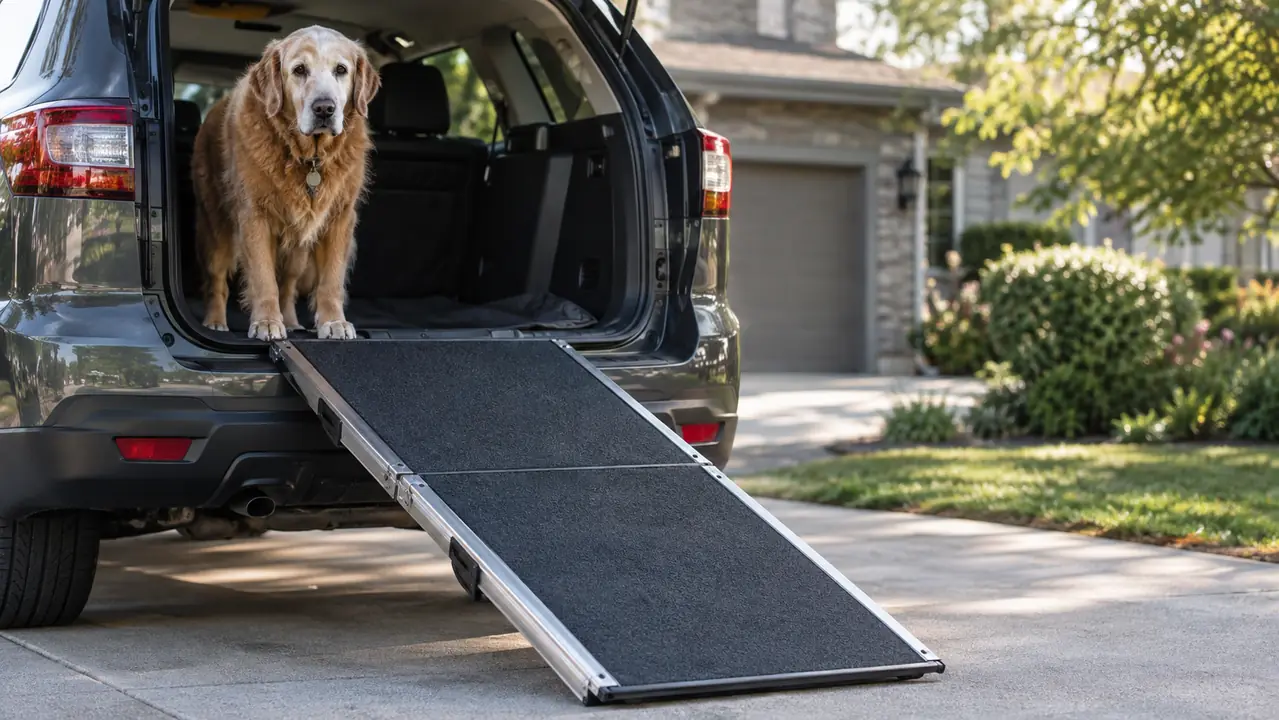
The first time I watched Biscuit hesitate at the back of my SUV, I told myself it was just the heat. Then it happened again the next morning, and the morning after that. Biscuit is an 11-year-old yellow Lab mix, about 74 pounds, with stiff back hips that are worst first thing in the morning and after long naps. Getting into the car had become a two-person job, and I could see him bracing himself before every jump. I spent 24 years as a veterinary technician, so I knew exactly what that hesitation meant. I also knew that letting him keep launching himself into a high cargo floor was not doing his hips any favors.
I tried lifting him for a while, but at 74 pounds, that was hard on both of us. I looked at dog stairs, but the idea of him missing a step made me cringe. Then I ordered the PetSafe Happy Ride Folding Dog Ramp, and after months of daily use, I have strong opinions about it. Here is the short version: it has made every single car ride easier, it has held up to daily abuse, and it is not perfect. I will tell you exactly where it shines and where it falls short.
The Quick Verdict
The PetSafe Happy Ride ramp is the best tool I have found for getting a senior dog in and out of an SUV without lifting. It is sturdy, folds flat, and Biscuit learned to use it in about a week. It is not a cure for arthritis, and it will not work for every dog, but for a 74-pound Lab mix with stiff hips, it has been a daily lifesaver.
Amazon Check Today's Price →Stop Lifting Your Senior Dog Into the Car
The PetSafe Happy Ride folding ramp gives your dog a steady, low-angle walk into the car instead of a risky jump. See today's price on Amazon and read what 15,000+ owners say.
Amazon Check Today's Price on Amazon →How I've Used It
I have used this ramp nearly every day for the past five months. Biscuit and I drive to the park, to the vet, and to my daughter's house across town. That means the ramp has been set up and taken down hundreds of times, in driveways, parking lots, and once in the rain outside the clinic. On a typical week we make four or five trips, and each trip means the ramp goes up and comes down at least twice, so I have had plenty of chances to learn its habits and its quirks.
My routine is simple. I keep the ramp folded flat in the back of the SUV, under a rubber mat. When we get to the car, I unfold it, hook the top lip over the edge of the cargo floor, and let the bottom rest on the ground. The ramp has a textured surface, so Biscuit's paws do not slip even when the ramp is wet. I stand beside him, give him a moment to look at it, and he walks right up. The whole setup takes me about thirty seconds now, and I have timed it. The first few times it took closer to two minutes while I fumbled with the locking mechanism, but that learning curve flattened out fast.
The ramp is rated for dogs up to 200 pounds, which sounded like marketing until I actually used it. Biscuit is 74 pounds, and the ramp does not flex or bounce under him. It feels solid. The folding design locks into place with a simple mechanism, and I have never had it collapse or shift while he was on it. I have also used it with a friend's 90-pound German Shepherd when I was watching her for a weekend, and even at that weight the ramp stayed steady with no wobble at the hinge.
Why I Stopped Lifting and Started Using a Ramp
For months, I lifted Biscuit into the car. I am 61 years old, and he is 74 pounds. That math was never going to work long term. Every time I lifted him, I could feel the strain in my own back, and I could see the fear in his eyes. He was not being stubborn. He was in pain, and he was scared of falling. One morning in late September he braced all four legs and refused to move, and I stood there in the driveway with my hands under his chest, both of us miserable. That was the morning I started looking seriously at ramps.
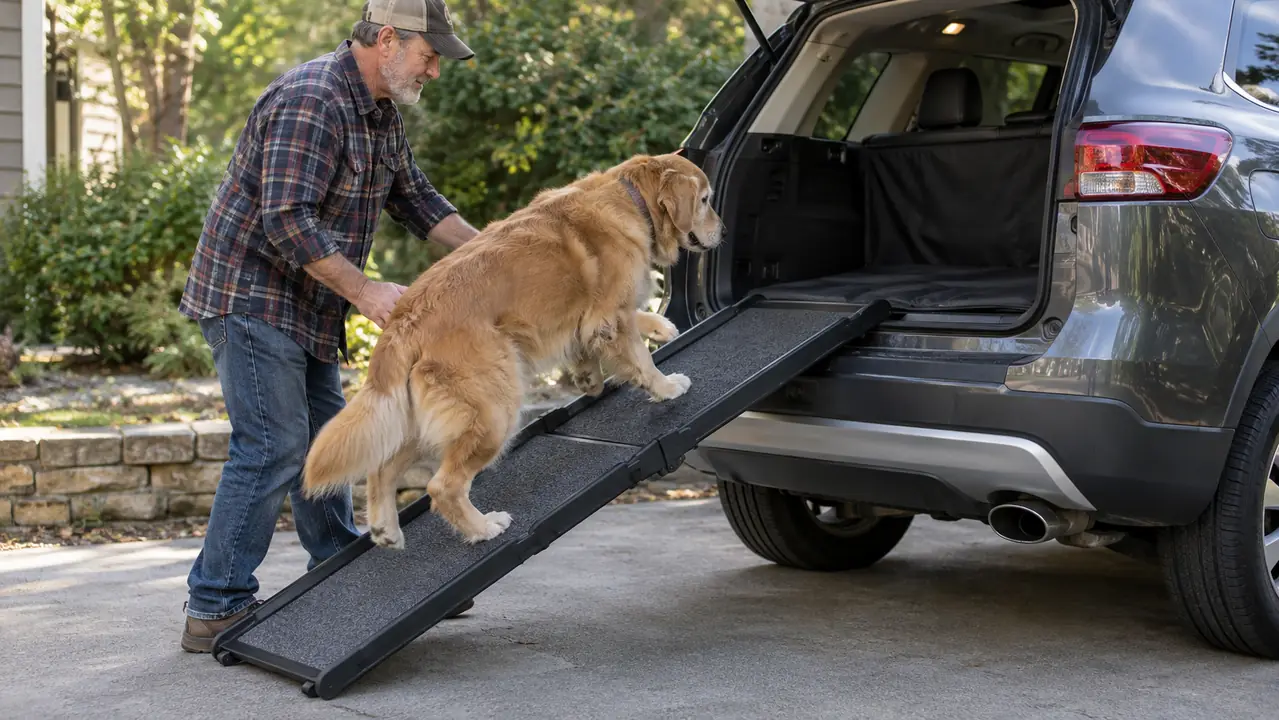
A ramp changes the whole equation. Instead of a jump that lands hard on stiff hips, Biscuit takes a gentle walk up a slope. The angle is low enough that he does not have to stretch or strain. He walks up at his own pace, and he walks down even more carefully. For a dog with arthritis, that controlled descent is worth the price of the ramp on its own. I have watched him take the descent one careful step at a time, front paws leading, and I know he is not slamming his hips the way he used to when he jumped.
I want to be clear about something: a ramp does not fix arthritis. It does not reduce inflammation or rebuild cartilage. What it does is remove one of the most stressful movements from your dog's day. If your dog is already limping or showing signs of pain, talk to your veterinarian before you change anything. A ramp is a tool, not a treatment. I tell every owner the same thing I would have told them when I was working at the clinic: manage the pain with your vet, and then make the environment easier for the dog.
What It's Like to Set Up and Take Down
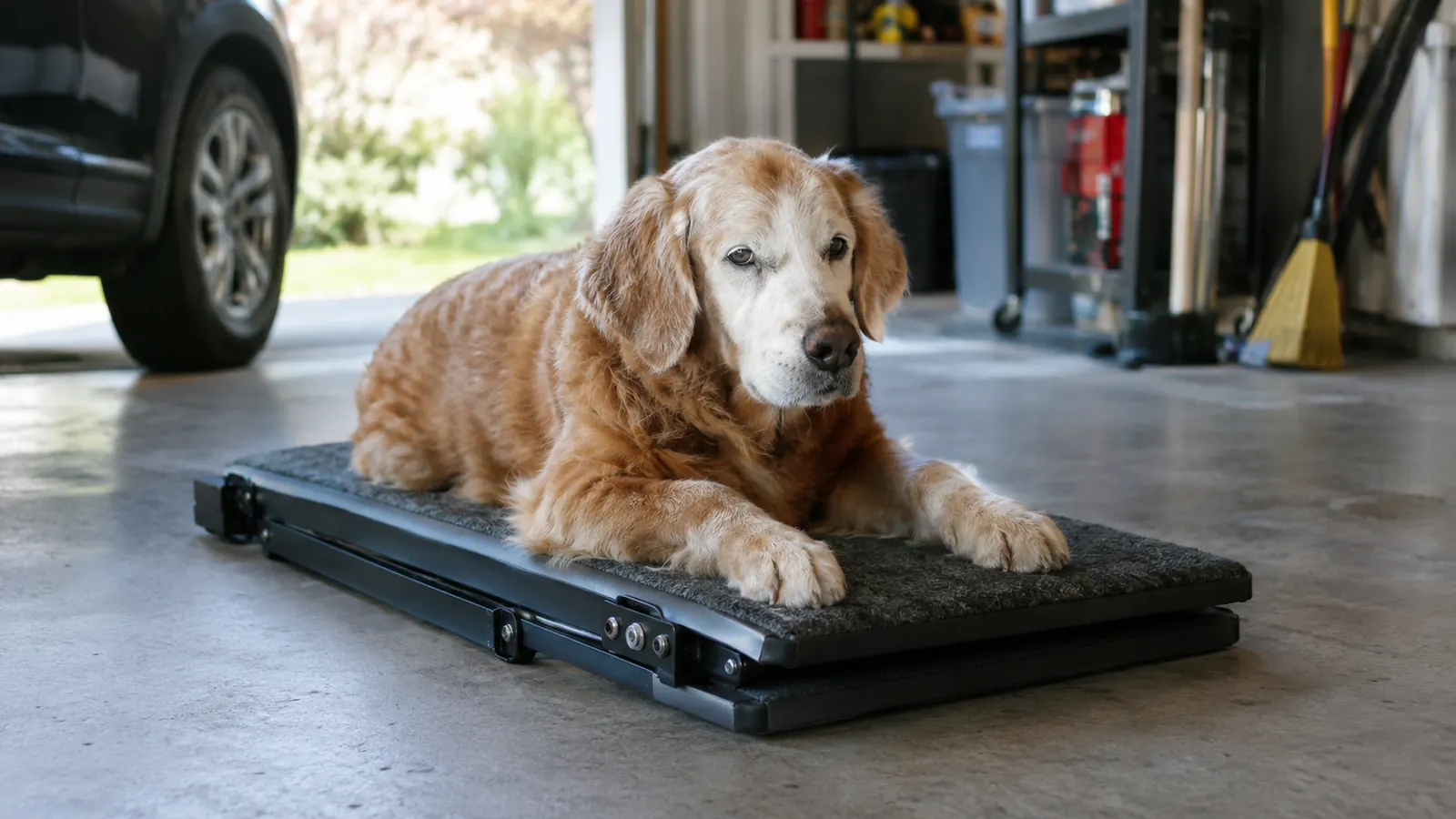
The PetSafe Happy Ride ramp folds in half, which makes it compact enough to store in the back of my SUV. Unfolding it takes a few seconds. There is a locking mechanism that keeps the two halves from folding while your dog is on it, and I have never had it slip. The whole thing weighs about 12 pounds, so I can carry it with one hand. When it is folded, it is roughly the size of a large suitcase, and it slides right in beside my spare tire kit without taking up the whole cargo area.
The surface is a textured, non-slip material that gives Biscuit's paws traction even when the ramp is wet. That matters more than I expected. We got caught in a light rain a few weeks ago, and I was worried he would refuse to walk on a wet ramp. He did not hesitate. The texture held, and he walked right up. I have also used it on a dewy morning when the grass was slick, and the ramp itself was still grippy under his paws. I do wipe it down with a damp cloth every couple of weeks, mostly to keep the dirt from building up in the texture.
One thing I will note: the ramp is not a lightweight accessory. It is sturdy, and sturdy means it has some heft. If you have back problems or limited strength, you may find it awkward to carry. I manage fine, but I would not want to haul it across a large parking lot every single day. I keep it in the back of the SUV so I only have to carry it the few steps from the car to the curb, and that works well for me.
How Biscuit Learned to Use It
I was prepared for a long training process. Biscuit is a senior dog, and seniors are often set in their ways. The first time I put the ramp down, he sniffed it, looked at me, and walked around it. I did not push him. I put a treat at the top, then another treat halfway up, and let him figure it out at his own pace. The first successful trip took about four minutes, and he looked very proud of himself when he reached the cargo floor.
By the third day, he was walking up without treats. By the end of the first week, he was waiting at the back of the car for me to set the ramp up. That surprised me. I expected weeks of coaxing. Instead, he seemed to understand that the ramp meant no more jumping, no more pain, no more being lifted. He still gets a small biscuit when he gets in, but that is more for the ritual than for the training.
The descent took longer. Dogs naturally want to jump down, and Biscuit tried to do that a few times. I held his collar and walked down beside him, keeping his pace slow. After a few weeks, he learned to walk down with his front paws leading, one careful step at a time. Now he does it on his own, and I can see the difference in his hips. He is not landing with a thud anymore. I have also noticed that he is less stiff in the first few minutes after a car ride, which makes sense because he is not jarring his joints on the way out.
The first time Biscuit walked up the ramp without hesitating, I almost cried. He was not bracing himself. He was not scared. He just walked into the car like it was the most normal thing in the world.
Where the PetSafe Happy Ride Ramp Falls Short
I promised myself I would not write a review that pretends everything is perfect. The PetSafe Happy Ride ramp has real limitations, and you should know them before you buy. I have recommended this ramp to friends, but I have also told them exactly what I am about to tell you.
First, the ramp is not ideal for very small dogs. The surface is wide and the slope is gentle, but a 10-pound dog may not need a ramp at all, and the size of the ramp can feel intimidating. This is really a product for medium to large dogs, especially seniors with mobility issues. If you have a small dog that is already struggling, a smaller ramp or a set of stairs is probably a better fit.
Second, the ramp works best on SUVs and trucks with a flat cargo floor. If you drive a sedan, the trunk opening is often too low and too narrow for the ramp to sit at a comfortable angle. I have only used it with my SUV, so I cannot speak to every vehicle, but I would measure your cargo opening before ordering. The top lip needs something solid to hook onto, and a rounded trunk edge will not hold it the same way.
Third, the ramp is not a substitute for veterinary care. If your dog is in significant pain, refusing to walk, or limping, a ramp will not fix the underlying problem. Please talk to your vet. I say this as someone who spent 24 years in a clinic: I have seen too many owners try to solve a medical problem with an accessory. The ramp is a comfort tool, not a treatment, and I do not want anyone to read this review and skip a vet visit because the ramp seemed to help.
What I Liked
- Sturdy, stable surface that does not flex under a 74-pound dog
- Folds flat for easy storage in the back of an SUV
- Textured, non-slip surface works even in the rain
- Low angle is gentle on arthritic hips and knees
- Quick to set up and take down once you get the hang of it
- Rated for dogs up to 200 pounds, so it grows with your dog
Where It Falls Short
- Heavier than some competing ramps, which can be awkward to carry
- Not ideal for small dogs or low vehicles like sedans
- Takes a few weeks for some dogs to learn to walk down
- Does not fix the underlying joint condition, only the movement
Who This Is For
This ramp is for anyone with a medium to large dog who is starting to struggle with getting into the car. It is especially useful for senior dogs with arthritis, hip dysplasia, or general stiffness, because it removes the high-impact jump that aggravates those conditions. It is also for owners who are tired of lifting a heavy dog and risking their own back. If you have already noticed your dog pausing at the car door, or if you have started counting the days until they cannot make the jump at all, this ramp is worth a serious look.
If your dog is still young and springy, you may not need a ramp yet. But if you have an older dog, or a dog with a known joint condition, I would rather you buy the ramp now and teach your dog to use it while they are still comfortable, than wait until they are in pain and resistant to new things. That is the advice I give every owner who asks me about mobility aids. It is much easier to introduce a ramp on a good day than on a bad one.
Who Should Skip It
Skip this ramp if you have a very small dog, a dog that is comfortable jumping in and out of a low vehicle, or a dog that is terrified of new surfaces and will not be trained. Some dogs will simply refuse to walk on a ramp, and no amount of treats will change that. If your dog is one of them, a set of dog stairs or a lift harness may be a better fit. I have known dogs like that from my clinic days, and pushing them onto a ramp only makes the fear worse.
Also skip it if your dog is in active pain or has a sudden limp. That is a veterinary emergency, not a ramp problem. Get your dog to the vet first, and ask them whether a ramp is appropriate for your dog's specific condition. I am not a vet, and I would never want a reader to delay real medical care because of a review. The ramp helped Biscuit because his stiffness was manageable and his vet had already given him a clear plan for his hips.
Give Your Senior Dog a Safer Way Into the Car
After months of daily use, the PetSafe Happy Ride ramp is the one mobility tool I reach for every single day. Check today's price on Amazon and see if it fits your dog and your vehicle.
Amazon Check Today's Price on Amazon →