
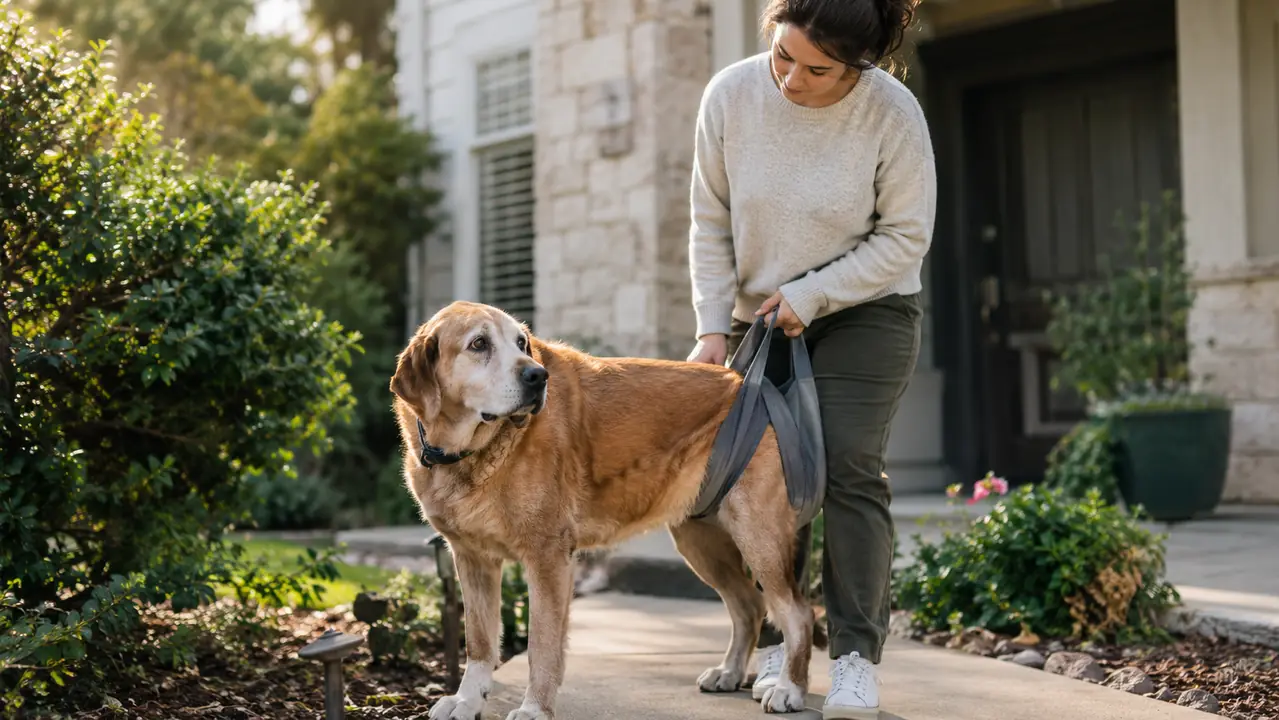
The first time I tried to help Biscuit up the three back steps, I grabbed the loose skin around his hips and pulled. He turned his head and gave me a look that said, plainly, that I was doing it wrong. I am a retired veterinary technician with 24 years in a small-animal clinic, and I still had no idea how to lift a 74-pound dog without hurting him or myself. That is how the LOOBANI rear support sling ended up in my cart.
Biscuit is an 11-year-old yellow Lab mix with stiff back hips, especially in the morning and after a long nap. He can still walk, but he hesitates at the back steps, and getting into the SUV has become a two-person production. I have now used the LOOBANI sling every day for months, through good weeks and bad ones, and this is the honest long-term review I wish I had read before I bought it.
The Quick Verdict
The LOOBANI rear support sling is the most useful mobility tool I own for a big dog with weak back legs. It does not fix the underlying joint problem, but it gives me a safe, comfortable way to take weight off his hips for the two or three minutes it takes to get up, down, and into the car. Buy it if you are the one doing the lifting.
Amazon Check Today's Price →Stop pulling on your dog's hips and start lifting the way your back will thank you for
The LOOBANI rear support sling takes the weight off weak back legs and puts it in your hands, where it belongs. It is the tool I reach for every single day with my 74-pound senior dog.
Amazon Check Today's Price on Amazon →How I've Used It
I keep the LOOBANI sling hanging on a hook by the back door, next to Biscuit's leash. That placement matters, because the sling only helps if it is within arm's reach at the exact moment you need it. In a typical day I use it four or five times: once to help Biscuit stand up from his bed in the morning, once or twice for the three back steps to the yard, once to get him into the SUV for his short ride to the park, and once more at night when his hips are stiffest.
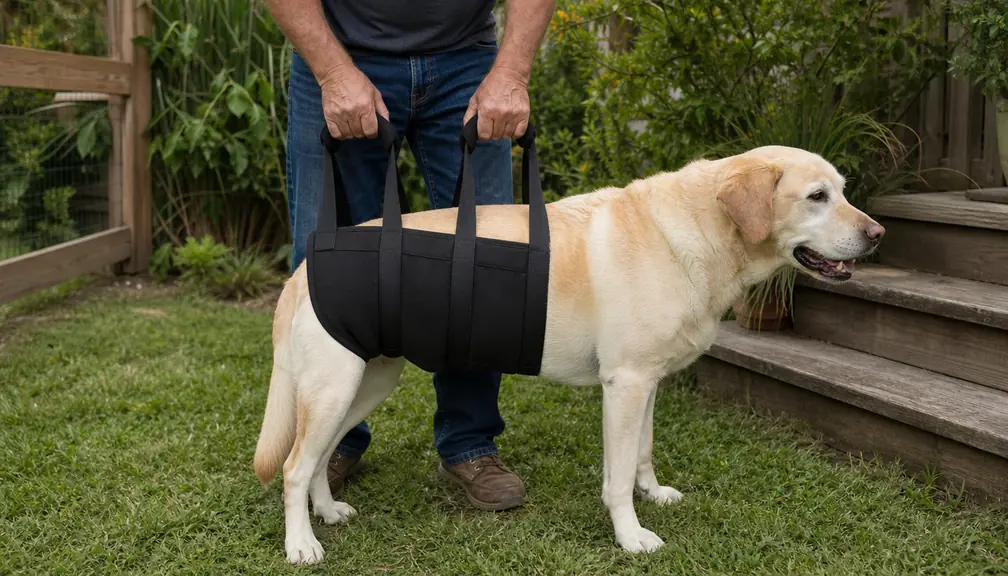
The routine is simple. I slide the wide fabric panel under his belly, just ahead of his back legs, and bring the two padded handles up on either side of his rear. When he stands, I take most of his weight on the handles and let him do the walking. On the steps, I stand behind him and lift with my legs, not my back, while he takes each step himself. In the car, I lift his rear end to cargo-floor height while he puts his front paws on the bumper and climbs.
The first week felt awkward for both of us. Biscuit had to learn that the sling meant he could trust his back end again, and I had to learn to stop over-lifting. By the second week, he started backing his rear end toward me when he saw the sling in my hand. That is when I knew it was working.
What helped most that first week was practicing when nothing was at stake. I would put the LOOBANI sling on Biscuit in the living room, lift just enough to take a little weight, walk him across the rug, then take it off and give him a piece of his dinner kibble. No steps, no car, no rush. By the fourth day he would stand still when he saw it come off the hook, and by the end of the week he was leaning into it instead of sidestepping away. If you skip this part and go straight to the stairs, your dog learns that the sling means the hard thing is about to happen, and you are fighting him instead of helping him.
What the LOOBANI Sling Actually Does
The LOOBANI rear support sling is a wide piece of durable fabric with two long handles that you hold like a pair of reins. You place it under the dog's belly, just in front of the hind legs, and lift gently. The design spreads the support across a broad area instead of concentrating it in one narrow strap, which matters for a dog with a sensitive back end.
What it does is simple: it transfers weight from your dog's back legs to your hands. That takes pressure off stiff hips and weak muscles for the short bursts of effort that are hardest for a senior dog. Standing up from a lying position, climbing three steps, stepping up into an SUV, these are the moments when a dog with hip problems hesitates. The sling removes the hesitation because the dog learns that the scary part is no longer entirely on him.
What it does not do is treat the underlying condition. Biscuit still has stiff hips. The sling does not reduce inflammation, rebuild cartilage, or replace veterinary care. I want to be blunt about that because there is a lot of marketing out there that makes mobility aids sound like cures. This is a tool, not a treatment. It makes the hard parts of daily life easier while you work with your veterinarian on the actual joint health plan.
In practical terms, the most useful thing the LOOBANI sling does is let me control the speed. A dog with weak back legs tends to rush the steps, because going fast feels safer to him than standing on a sore hip for a second longer. When I have the handles, I can slow Biscuit down to one step at a time, let his back feet find the tread, and take just enough weight that his hips do not buckle. On the way up, I lift a little more on the push from the bottom step. On the way down, I hold back so he does not pitch forward. That control is the part no product photo shows you, and it is what made me trust it.
Months of Daily Use: What Held Up and What Did Not
After months of daily use, the LOOBANI sling shows honest wear. The fabric has softened and molded to Biscuit's shape, which actually made it more comfortable over time. The stitching around the handles is still intact, and the handles themselves have held up to a lot of pulling. I have washed it twice on a gentle cycle and hung it to dry, and it came out looking almost new.
The one thing I would change is the handle padding. The foam inside the handles is adequate, but on a heavy lift, like the first step into the SUV, I can feel the pressure in my palms. It is not painful, and it has not worn out, but I would happily trade a little extra padding for a little more comfort on the hardest lifts. For a dog much heavier than 74 pounds, I would want a second person on the other handle.
I also learned that the sling works best when you use it before the dog is exhausted. If I wait until Biscuit is already struggling, he is less coordinated and the lift is harder for both of us. Using the sling early, as a preventive assist rather than a rescue, made the biggest difference in how smoothly our routine goes.
Washing has been simple. I run the sling through a cold cycle with his blankets about every two weeks, more often after a muddy stretch in the yard, and hang it over the back of a chair to dry overnight. I keep the handles out of the dryer, because heat is hard on foam padding and I would rather not find out how much it can take. The stitching where the handles meet the fabric is the place I check most closely, since that seam carries most of his weight every time I lift. Months in, it is still tight. I also check the underside for rough spots, because anything that rubs his belly every day will eventually leave a sore.
The first time Biscuit backed his rear end toward me when he saw the sling in my hand, I knew it was working. He had learned to trust his back end again.
How It Compares to Other Ways of Lifting a Senior Dog
Before the LOOBANI sling, I tried the two methods most people try first. The first was the towel trick, folding a bath towel under his belly and lifting the ends. It worked in a pinch, but the narrow towel rolled up into a rope and concentrated all the pressure into a thin line across his belly. Biscuit tolerated it, but he did not like it, and neither did my lower back.
The second was a rigid lifting harness with handles along the top. It distributed weight well, but it was a production to put on. Biscuit had to step into it, I had to buckle it, and by the time we were ready to go outside, he had already lost interest. The LOOBANI sling takes about five seconds to position and requires no buckling, no stepping in, and no cooperation from a stubborn dog beyond standing still for a moment.
I have also seen full-body slings with leg holes at the clinic. Those are excellent for dogs recovering from surgery who need maximum support, but they are overkill for a dog who just needs help with steps and the car. For Biscuit's situation, the LOOBANI sling hits the sweet spot between the towel that does not work well and the full harness that takes too long to put on.
My own back has a vote in this too, and I think it is worth saying out loud. Before the LOOBANI sling, getting Biscuit up the steps meant bending at the waist, wrapping both arms around his hind end, and lifting most of 74 pounds with my back. I am 61, and a couple of weeks of that left me sore every evening. With the sling, I stand nearly upright, my arms do the work, and I am only lifting the share of his weight his back legs cannot manage. For an owner who is not young either, that difference matters. A tool that protects the person doing the lifting is a tool that actually gets used every day.
What I Liked
- Takes real weight off weak back legs and puts it in your hands
- Five seconds to position, no buckles or straps to fight with
- Wide fabric panel spreads pressure so it is comfortable for the dog
- Padded handles are easy to grip, even with arthritis in my own hands
- Washes well and has held up to months of daily use
- Works for steps, getting into the car, and helping a dog stand up
Where It Falls Short
- Handle padding is adequate but not plush on the heaviest lifts
- You still have to do the lifting, so it does not replace a second person for very heavy dogs
- It is a mobility aid, not a treatment for the underlying joint problem
- Takes a week or two for some dogs to get used to the feeling
Who This Is For
The LOOBANI rear support sling is for anyone who is the primary lifter for a medium or large dog with weak back legs. If your dog hesitates at the steps, struggles to get into the car, or needs help standing up after a nap, this sling will make those moments safer for both of you. It is especially useful for older owners who need to protect their own backs while still giving their dog the help he needs.
It is also for dogs who are still mobile enough to walk on their own but need a little help with the hard parts. Biscuit walks a quarter mile every morning, but he cannot get into the SUV without help. The sling bridges that gap. It lets him keep his independence for the things he can do while giving me a safe way to help with the things he cannot.
Who Should Skip It
Skip the LOOBANI sling if your dog cannot bear weight on his back legs at all. A sling is a support tool, not a wheelchair. If your dog needs to be fully carried, or if he is recovering from surgery and needs the kind of controlled support only a full-body harness or a veterinary professional can provide, this is not the right tool.
Skip it if you are looking for something that will fix the underlying joint problem. No sling, harness, or towel will do that. If your dog is limping, in obvious pain, or suddenly unable to use his back legs, do not order a mobility aid. Call your veterinarian. That is the conversation that matters, and it is the one I always had with clients at the clinic when they asked me what to buy.
Give your dog the help he needs without wrecking your own back
Months of daily use have convinced me that the LOOBANI rear support sling is the right tool for a senior dog who still wants to move. If that sounds like your dog, it is worth a look.
Amazon Check Today's Price on Amazon →