
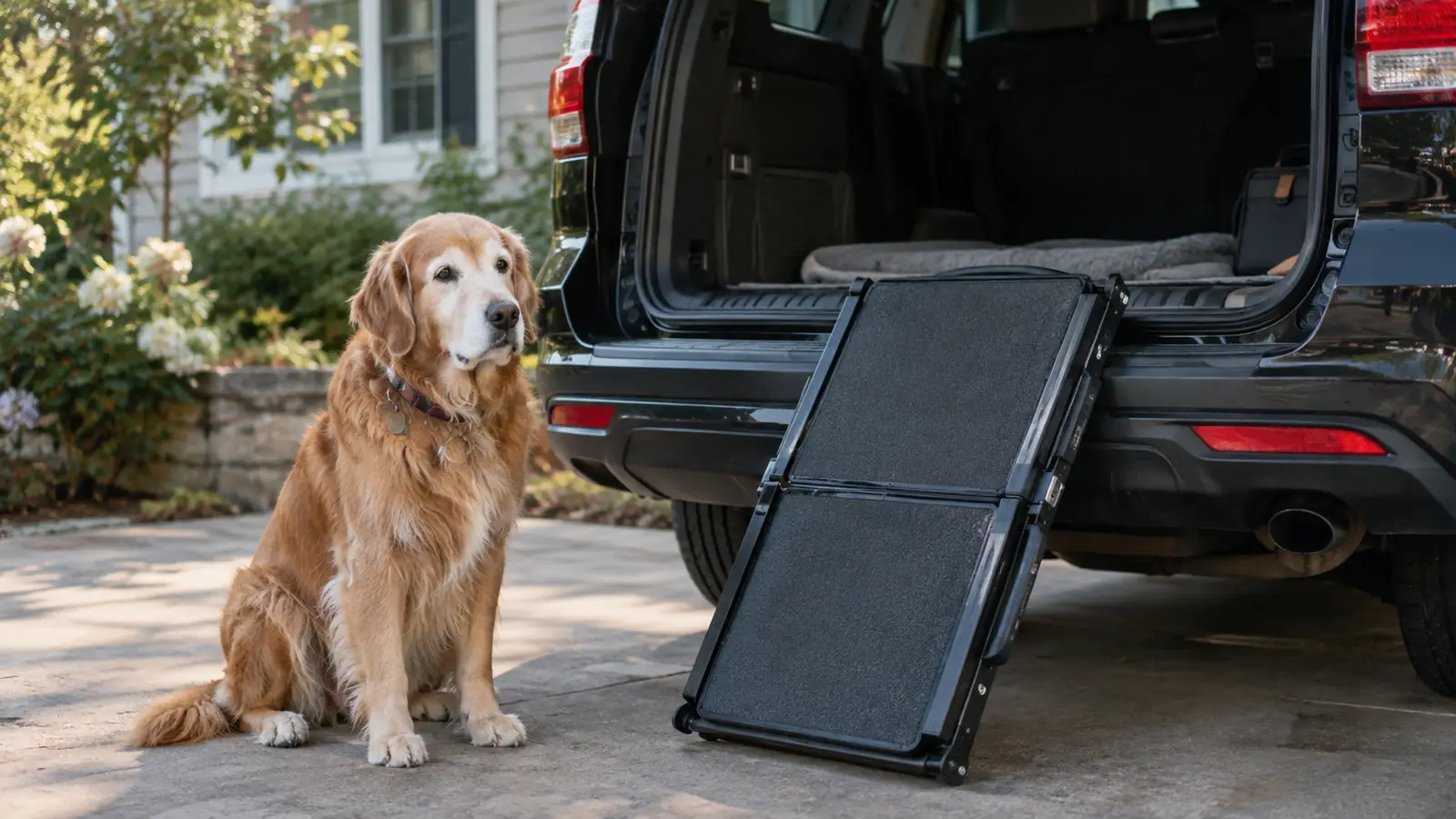
The morning it really hit me was a Tuesday in late September. Biscuit, my 11-year-old yellow Lab mix, planted all four feet at the bottom of the open tailgate and just looked at me. He did the little shift of weight he does when he is thinking about jumping, then he sat down. I stood there with my hand on his collar, doing the math I had been doing for months: 74 pounds, a cargo floor about 30 inches off the ground, and a dog whose back hips have been stiff since spring. I bent down, got my arms under his chest and back end, and lifted. He let me do it, but he let out a small grunt, and I felt the kind of guilt that sits in your chest all day. This is how a PetSafe folding ramp finally ended the lifting.
I spent 24 years as a veterinary technician, so I knew exactly what was happening in those hips. The cartilage thins, the joint fluid gets less slippery, and the muscles around the hip have to work harder just to do the same job. Biscuit was not in pain that morning, not the way a dog with a torn ligament is in pain. He was stiff, and stiffness makes a dog hesitate. The hesitation is the part that breaks your heart, because you can see them want to do the thing they have always done, and their body just will not cooperate.
I had tried a few workarounds before I finally bought the PetSafe Happy Ride Folding Dog Ramp. I tried a set of plastic pet stairs, the kind you see in every pet store. They worked in the house, where Biscuit could take them one step at a time on a level floor. At the car, they were a disaster. The stairs wobbled on the pavement, the top step sat lower than the cargo floor, and Biscuit looked at the gap like I was asking him to jump a creek. He would put one paw on the first step, feel it shift, and back away. I tried lifting him with a towel sling under his belly, which helped my back but did nothing for his dignity or his confidence. He hated it. He would tuck his tail and brace his front legs, and I would end up half carrying a 74-pound dog who was doing his best to help but had no idea what I wanted from him.
What finally changed my mind was a Saturday trip to the groomer. Biscuit had a bath scheduled, and I knew the drill: open the tailgate, lift him in, drive, lift him out, lift him back in, drive home, lift him out again. That is four lifts in one morning, and by the third one my lower back was talking to me. I stood in the parking lot with Biscuit waiting beside me and thought about the next five years. He is 11 now. If I keep lifting him, I am going to hurt myself, and he is going to keep dreading the car. Neither of those things is okay.
The first time Biscuit walked up the ramp on his own, he did it like he had been doing it his whole life. No hesitation, no grunt, no guilt in my chest.
Stop Lifting. Start Letting Your Dog Walk In.
The PetSafe Happy Ride Folding Dog Ramp gives your senior dog a stable, padded path into the car, and it gives your back a break. It folds flat for storage and adjusts to fit your vehicle.
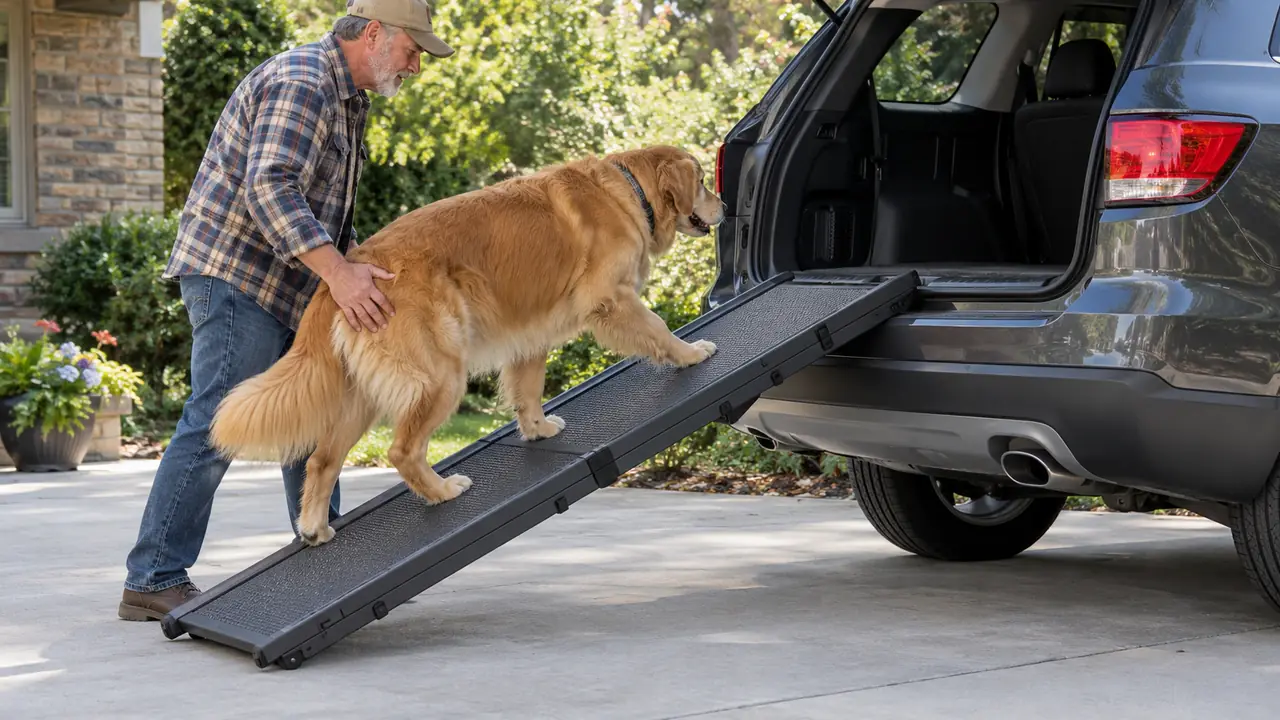
Amazon Check Today's Price on Amazon →The PetSafe ramp arrived two days later, and I will be honest: I was skeptical when I first unfolded it. The ramp is made of two panels that fold in half, with a hinge in the middle and a strap that locks the panels flat. The walking surface is a textured plastic with raised ridges, and there is a lip at the top that hooks over the edge of the cargo floor. The whole thing weighs about 12 pounds, which meant I could carry it with one hand and hold Biscuit's leash with the other. That alone felt like a small victory.
The first attempt did not go perfectly. I set the ramp at too steep an angle, and Biscuit took one look at it and sat down again. I adjusted the strap so the ramp sat flatter, with the bottom edge farther from the car, and that made the difference. The angle matters more than I expected. When the ramp is too steep, a stiff dog looks at it and sees a wall. When it is flatter, it reads as a walkway. Biscuit put one front paw on the textured surface, then the other, then his back feet followed. He walked up like he had been using a ramp for years, turned around in the cargo area, and lay down on his bed. I stood there with my hand on the tailgate and felt something I had not felt in months: relief.
The ramp has a few details I have come to appreciate after using it every week. The surface is wide enough that Biscuit's whole paw fits on it, which matters for a dog with hip stiffness. The hinge in the middle means the ramp folds down to about half its length, so it fits across the back seat or behind the front seats in my SUV. There is a carrying handle built into the frame, and the whole thing slides under the back seat when I do not need it. I have also used it at the three back steps down to my yard, where Biscuit used to pause every morning. He still takes the steps slowly, but he does not hesitate the way he did before, because he knows there is a gentler option if he needs it.
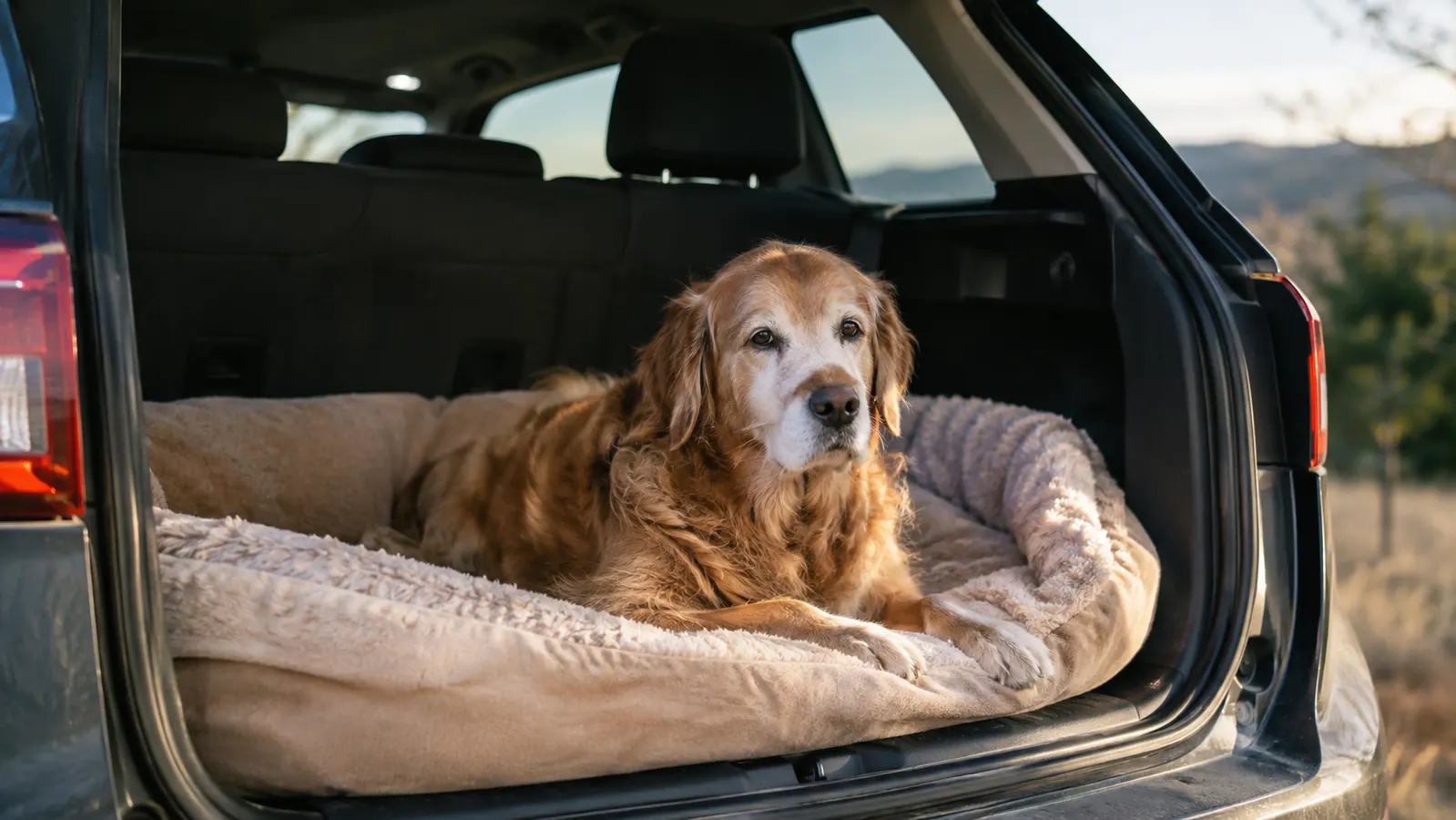
I want to be clear about what the PetSafe ramp did not do. It did not cure Biscuit's stiff hips, and I would never claim it did. He still moves slowly first thing in the morning. He still prefers the ramp to the steps on cold days. He still gets a little extra help from me when he is tired after a long walk. What the ramp did was remove the one part of his day that made him anxious. He does not dread the car anymore. He walks up the ramp, settles onto his bed, and rides with his head out the window like he is 5 years old again. That is not a magic fix. It is just a dog being allowed to do what he has always done, without being lifted like a sack of feed.
If your dog is starting to hesitate at the car, I would tell you the same thing I tell every friend who asks: do not wait until you are both frustrated. Watch how your dog approaches the tailgate. If he pauses, if he shifts his weight, if he looks at you instead of the car, that is the sign. A ramp is not giving up on your dog's mobility. It is giving your dog a way to keep doing the things he loves, on his own four feet, for as long as he can.
What I'd Tell You If We Were Sitting at My Kitchen Table
If we were sitting at my kitchen table with coffee, I would tell you this plainly. I am not a vet, and I am not going to diagnose your dog. If your dog is limping, crying out, or refusing to put weight on a leg, call your veterinarian. That is not a ramp problem. That is a medical problem, and it deserves a real exam, not an internet article.
But if your dog is like Biscuit, stiff but still willing, then I would tell you to think about the ramp the way I think about it now. It is a tool that lets your dog keep his independence a little longer. It is a way to protect your own back while you care for a dog who is getting older. And it is a small thing that makes a big difference in how your dog feels about the car, about the steps, about the parts of the day that used to be easy.
I still lift Biscuit sometimes. When he is tired after a long hike, or when the ground is wet and I do not want him to slip, I get my arms under him and do what I have always done. But those days are the exception now, not the rule. Most days, he walks up the PetSafe ramp on his own, turns around, and waits for me to close the tailgate. And I close it knowing I gave him a little more time to be a dog, and I gave my back a little more time to hold out.
Give Your Senior Dog the Car Rides He Still Loves
The PetSafe Happy Ride Folding Dog Ramp is the tool I wish I had bought a year earlier. If your dog hesitates at the tailgate, this is the fix that lets him walk in on his own.
Amazon Check Today's Price on Amazon →