
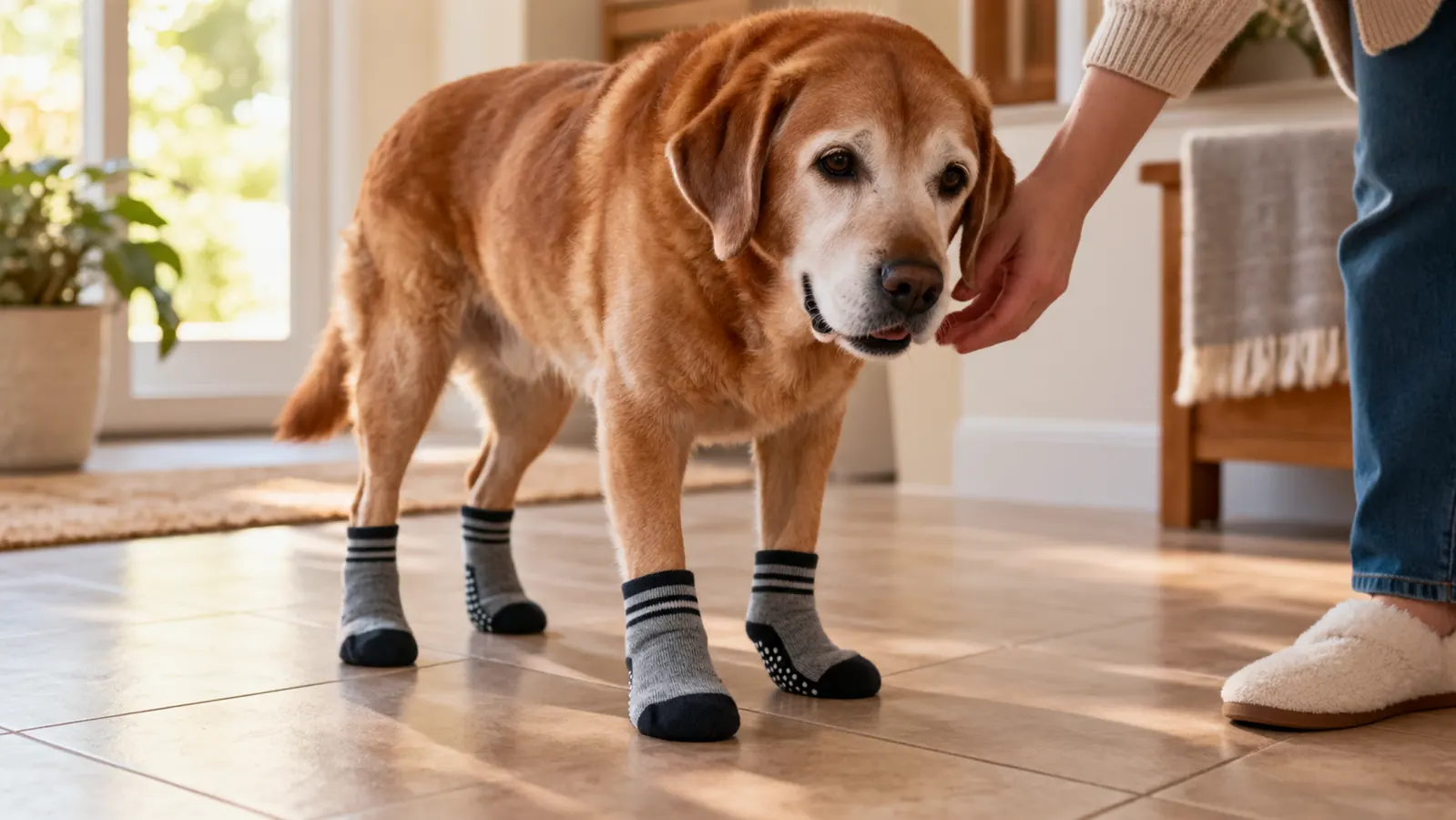
I spent 24 years as a veterinary technician, so I have watched a lot of senior dogs struggle on slippery floors. I have also watched a lot of owners buy things that did not help. When my own dog Biscuit, an 11-year-old yellow Lab mix, started doing the splits on our tile every time he stood up, I did what I always did at the clinic: I looked at the options, read the reviews, and tried the thing that seemed most practical. That thing was a pair of DOK TigerToes Non-Slip Dog Socks. This is the honest review I would give a friend, including the parts nobody puts on the product page.
Before I go any further, let me be clear about who I am and who I am not. I am not a veterinarian. I am a retired vet tech with a lot of hands-on experience, and I know what I saw with my own dog. If your dog is limping, yelping, or suddenly refusing to move, please talk to your own vet before you buy anything. Socks help with traction, not with pain. I will say that more than once, because it matters.
The Quick Verdict
TigerToes socks gave Biscuit his footing back on our tile and laminate floors. They are not a cure for arthritis, they take some getting used to, and they will not stay on every dog. But for a senior dog who is sliding and hesitating, they are the most practical fix I found.
Amazon Check Today's Price →If your dog is sliding on hard floors, this is the fix I reached for first
DOK TigerToes Non-Slip Dog Socks gave my 11-year-old Lab the traction he needed on our tile and laminate floors. They are not magic, but they worked for us. Check today's price on Amazon and see if they fit your dog's situation.
Amazon Check Today's Price on Amazon →How I Used Them and Why I Was Skeptical First
I will be honest: when I ordered TigerToes, I did not expect much. I had seen paw pads, sticky sprays, and at least three different brands of boots come through the clinic, and the results were always mixed. Some dogs tolerated them. Some dogs chewed them off before the owner got to the front door. Some products helped so little that the owner gave up within a week.
Biscuit's problem was specific. He has stiff back hips, especially first thing in the morning and after a long nap. On our tile floors, that stiffness meant his back feet would slide out from under him when he stood up. He started hesitating at the back steps and bracing himself before getting into the SUV. He was not in obvious pain, but he had lost confidence in his own footing. That loss of confidence is something I saw constantly at the clinic, and it is often the first sign that a dog is struggling more than the owner realizes.
I used the TigerToes socks on Biscuit for about six weeks before writing this. I put them on for the times of day when he was most likely to slip: first thing in the morning, after naps, and before he went down the back steps. I did not leave them on all day. I wanted to see whether they helped at the moments that mattered, and I wanted to give his paws plenty of time without anything on them.
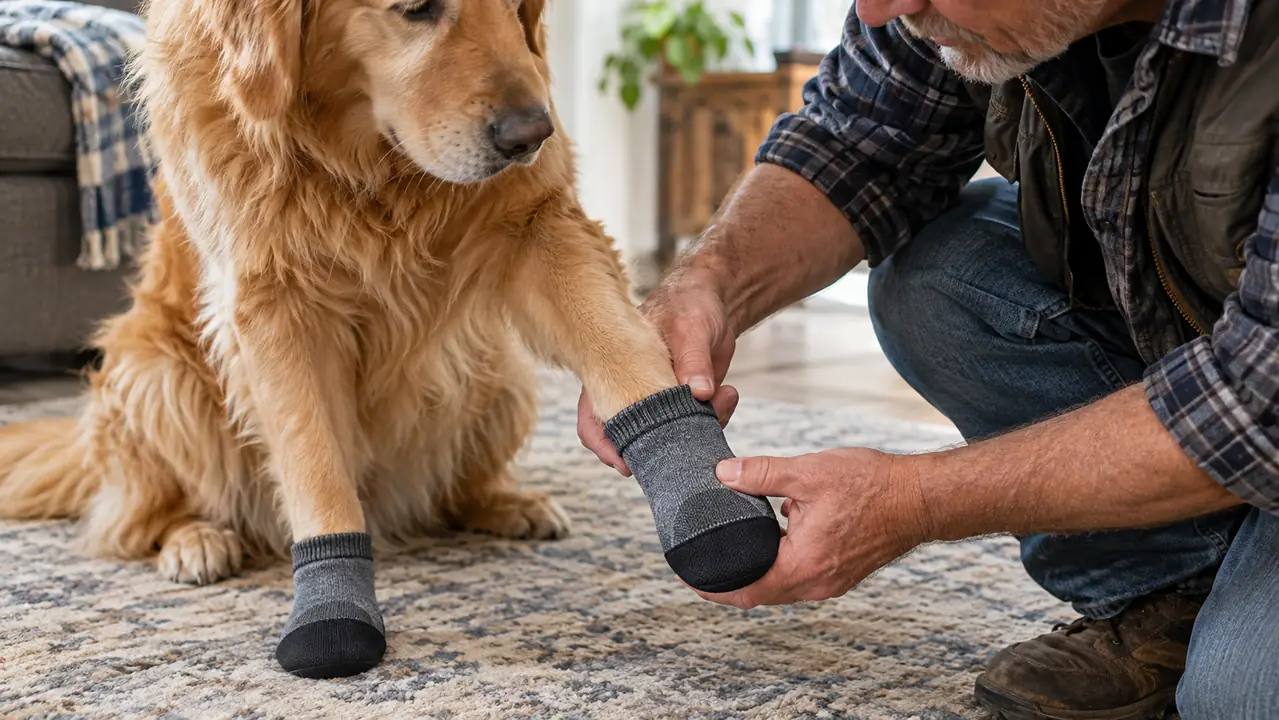
The first week was mostly about figuring out the routine. On day one, I put the socks on before his morning walk and he stood at the back door refusing to move. I sat on the floor with him for a few minutes, let him sniff the socks, and gave him a small treat for each paw. By day three he was walking to the door on his own. By the end of the second week I could put all four socks on in about two minutes. That first morning, it took closer to ten, and I almost gave up on the whole idea.
What Nobody Tells You About the Fit
The first thing nobody tells you is that sizing is the whole game. TigerToes come in sizes, and the size chart matters more than almost anything else. I measured Biscuit's paws the way the listing said to, checked the chart twice, and still had to adjust my expectations. His front paws are a little wider than his back paws, and the socks fit snugly on the front but slightly looser on the back. That is normal for a lot of dogs, but it means you should size for the paw that is most likely to slip, not the paw that fits the chart perfectly.
The second thing nobody tells you is that the socks are not instantly comfortable for every dog. Biscuit stood there looking at his feet like I had betrayed him. He walked stiff-legged for the first few minutes, lifting each paw high like he was stepping through snow. I have seen this reaction a hundred times with boots and socks, so I was not worried, but a lot of owners would be. Give the dog ten or fifteen minutes of supervised walking before you decide they hate it. Some dogs never get used to it, but many do.
The third thing is the one I wish someone had told me: the grip is on the bottom, and the bottom has to stay clean. The non-slip material works because it grabs the floor, but it also picks up dust, crumbs, and the occasional bit of whatever Biscuit stepped in. A quick wipe with a damp cloth fixes it. If you skip that, the socks get slicker over time and you will think they stopped working.
One more fit detail: the band at the top is not a suggestion. I learned this the hard way on a Tuesday morning when I put the socks on in a hurry and did not pull the bands up all the way. Biscuit took three steps, the sock on his right back paw bunched up around his ankle, and he stopped to shake it off. I fixed the band, and he was fine. The socks stay on best when the band sits above the ankle, not halfway down the paw.
How the Grip Actually Performed on Tile and Laminate
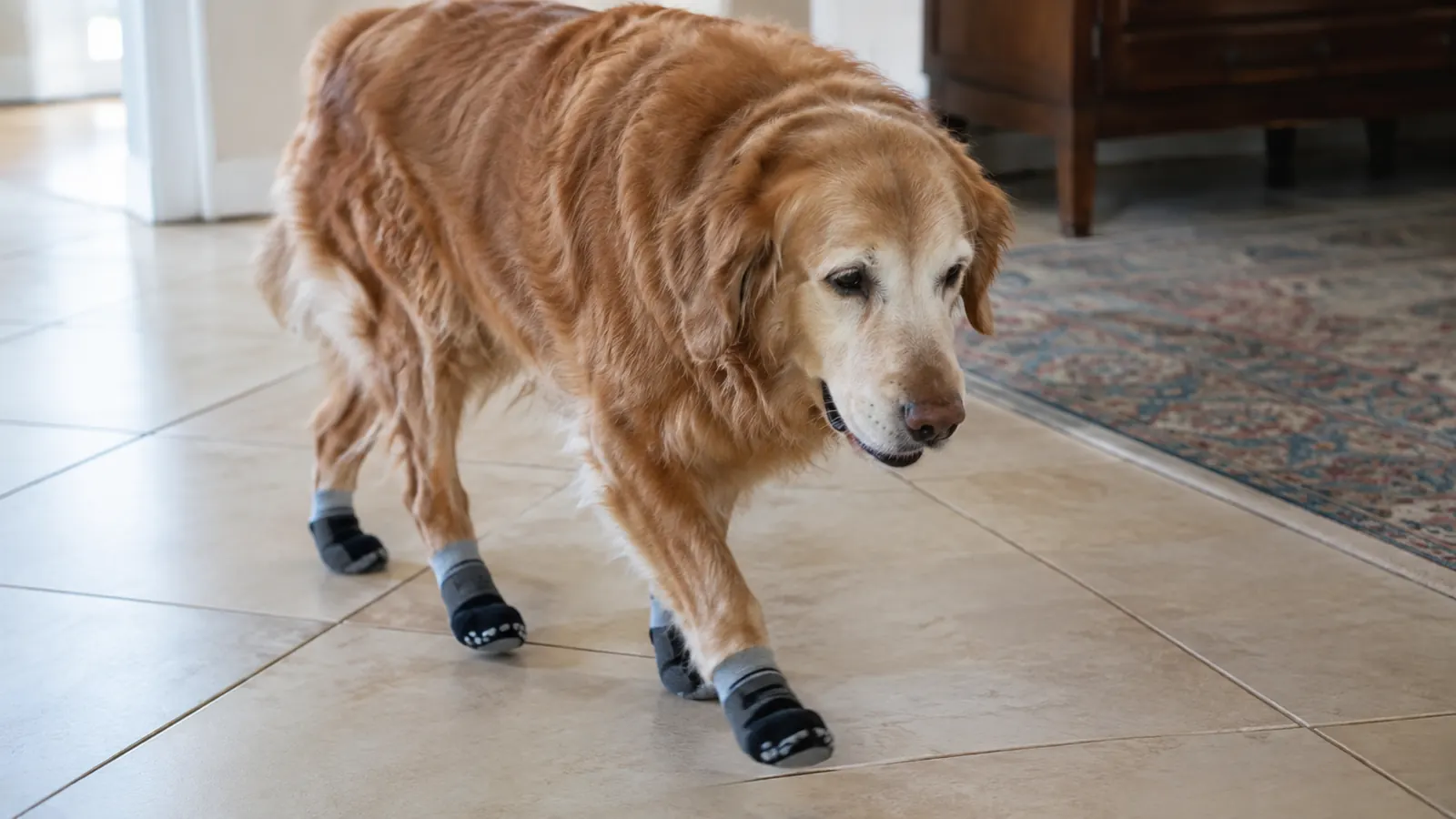
Here is the part that surprised me. I expected the socks to help a little. I did not expect Biscuit to stand up from a nap and walk across the tile without his back feet sliding. That is exactly what happened. The extra-thick grip on the bottom of the TigerToes socks gave him enough traction that he stopped doing the splits, and he stopped bracing himself before he stood up.
The difference was most obvious on the laminate floor in the hallway. Before the socks, Biscuit would walk slowly and carefully, with his feet spread wider than normal. With the socks on, his stride looked more like a normal dog's stride. He still had stiff hips in the morning, and he still needed a moment to get going, but he was not fighting the floor anymore. That is the win. The socks do not fix the hips. They fix the surface, and for a dog with stiff hips, a surface you can trust makes a real difference.
I also tested them on the three back steps down to the yard, which was the moment that worried me most. Biscuit has always been careful on those steps, but in the months before the socks arrived he had started pausing at the top and reaching down with one front paw before committing. With the socks on, he went down the steps the way he used to, one paw after the other, no hesitation. I watched him do it three mornings in a row before I believed it was the socks and not just a good day.
The socks do not fix the hips. They fix the surface, and for a dog with stiff hips, a surface you can trust makes a real difference.
What I Learned About Keeping Them On
The question I get from friends is always the same: do they stay on? For Biscuit, yes, most of the time. The socks have a band at the top that helps them stay up, and they stayed on during his normal walks around the house and down the back steps. He did manage to kick one off twice, both times when he was scratching his ear with his back foot. That is not a design flaw. That is a dog being a dog.
What I learned is that the socks work best when you check them before every use. A sock that has twisted sideways is not going to grip the way it should. I got into the habit of giving each paw a quick look before Biscuit stood up, and that thirty-second check saved us a lot of frustration. If your dog is the kind that chews at anything on their feet, these may not work for you. Biscuit never chewed at them, but I have seen plenty of dogs that would.
I also learned to keep a spare pair on hand. We had one evening when Biscuit came in from the yard and one sock was soaked through from a puddle I had not noticed. I dried his paw, put on a dry sock, and we were back to normal. If you are using these every day, a second pair means you are never waiting for one to dry.
Washing is part of keeping them on, too. A sock with dirt and hair packed into the grip pattern does not grab the floor the way a clean one does. I wash Biscuit's TigerToes on a cold cycle twice a week, inside a mesh laundry bag so they do not wander off, and let them air dry overnight on the counter. I keep them out of the dryer because heat is hard on rubber. Rotating two pairs means he always has a dry set ready, and the grip on each pair wears more slowly. If your dog wears socks daily, budget for a second pair from the start rather than waiting for the first one to wear out.
The Honest Downsides Nobody Mentions
Let me give you the downsides, because an honest review has to have them. First, the socks are not a substitute for managing the underlying joint stiffness. Biscuit still needs his slow morning start, his joint supplement, and his regular gentle exercise. The socks made the floor safe, but they did not make his hips young again. If you are hoping for a fix that removes the need for everything else, this is not it.
Second, they take time to put on. Not a lot of time, but more than zero. If you are rushing out the door and your dog needs socks before they go down the steps, you will need to build a few extra minutes into your routine. I kept the socks by the back door so I could put them on without hunting for them.
Third, they are not for every dog. A dog that chews, a dog that cannot stand having anything on their feet, or a dog that is already painful and resents being handled may never accept socks. I would not force it. If your dog is clearly distressed, take them off and talk to your vet about other options like rugs, runners, or paw pads.
Fourth, the grip wears down. After about five weeks of daily use, I noticed the tread on the pair Biscuit wore most often was not as grippy as it was on day one. The socks still worked, but I had to wipe the bottoms more often to keep them grabbing the tile. That is worth knowing before you buy, because it means you will probably replace them sooner than you would a pair of boots.
What I Liked
- Gave Biscuit real traction on tile and laminate floors within minutes of the first wear
- Stayed on during normal walking, including the three back steps down to the yard
- Easy to put on once you learn the routine, about two minutes for all four paws
- Lightweight and flexible, so Biscuit could still feel the floor under him
- Simple to clean with a damp cloth when the grips pick up dust
Where It Falls Short
- Sizing is tricky if your dog's front and back paws are different widths
- The grip picks up dust and crumbs and needs regular wiping to keep working
- Some dogs will never accept anything on their feet, no matter how patient you are
- The tread wears down with daily use, so you will likely need a replacement pair
- They do not address the underlying joint stiffness, only the slippery surface
Who This Is For
TigerToes socks are for the dog who is sliding on hard floors but otherwise comfortable. They are for the owner who has watched their senior dog hesitate at the back steps and wants to give them back some confidence. They are for the dog who needs a little extra traction at certain times of day, not a full-time boot. If that sounds like your dog, these are worth trying.
They are also for owners who are willing to handle paws every day. That daily check is part of the deal, and it is a good habit for any senior dog. If you can spare a minute in the morning and a minute at night, TigerToes give a sliding dog a lot back for very little effort.
Who Should Skip It
Skip these if your dog is in obvious pain, limping, or refusing to put weight on a leg. That is a vet visit, not a sock purchase. Skip them if your dog chews or destroys anything you put on their feet. Skip them if you are not willing to check the fit and clean the grips, because a sock that has twisted or picked up dust will not do its job. And if you are looking for a cure for arthritis, there is no such thing, and anyone who tells you otherwise is selling something.
The bottom line from a retired vet tech: give your dog a floor they can trust
DOK TigerToes Non-Slip Dog Socks gave Biscuit his footing back on our tile and laminate floors. They are not a cure, but they are a practical, affordable fix for a very common problem. Check today's price on Amazon and see if they are right for your dog.
Amazon Check Today's Price on Amazon →