
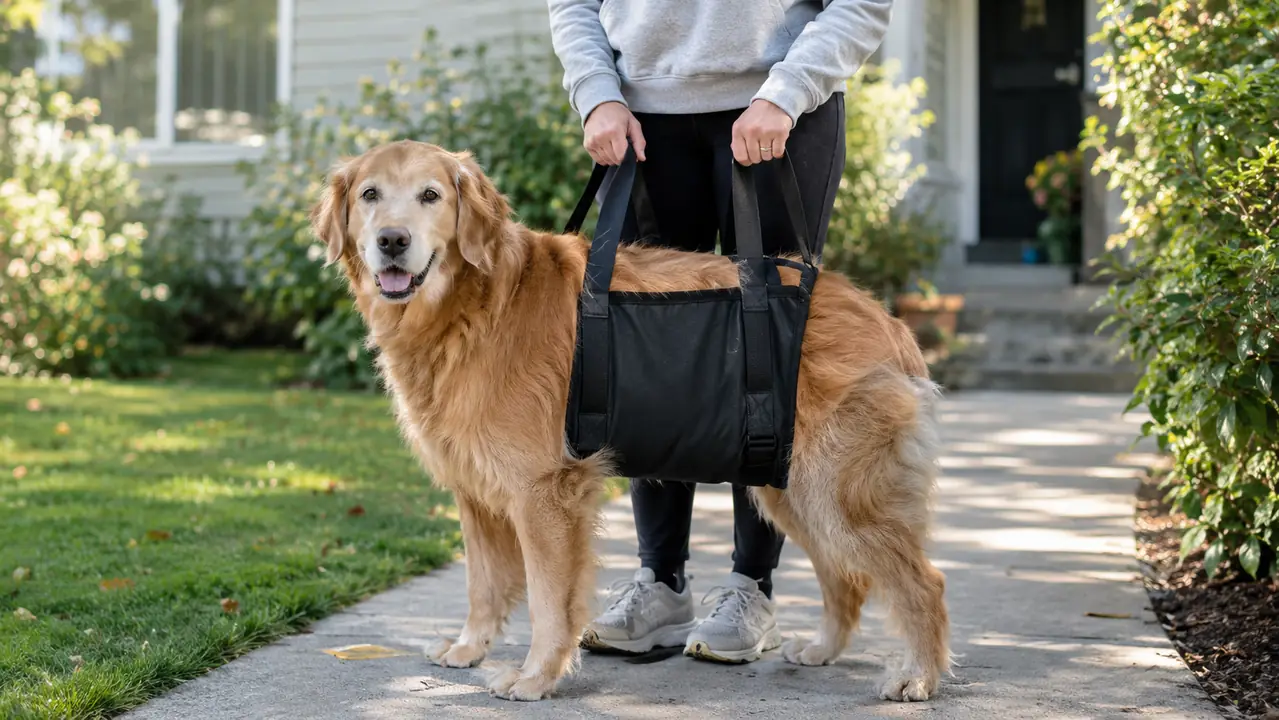
The first time I watched Biscuit hesitate at the back steps, I thought he was just being stubborn. He is an 11-year-old yellow Lab mix, about 74 pounds, and he has always been slow to wake up. But when he started parking himself at the top of those three steps and looking back at me like he was waiting for something, I realized this was not a mood. His back hips were stiff, especially first thing in the morning, and he did not trust his own legs to carry him down.
I spent 24 years as a veterinary technician, so I knew what was happening. The muscles around his hips were weakening, and on the tile and laminate floors in our house, his back feet would slide out from under him. The fix was not complicated, but it did require a little help from me. A rear support sling, used the right way, gave him back the confidence to move. Here is exactly how I did it, step by step, with the LOOBANI Adjustable Dog Sling for Large Dogs.
The Rear Support Sling That Helped My Senior Dog Move Again
The LOOBANI Adjustable Dog Sling for Large Dogs is the one I keep by the back door. It is padded, adjustable, and simple enough to use one-handed once you get the hang of it.
Amazon Check Today's Price on Amazon →Step 1: Get the Sling Fitted Before You Need It
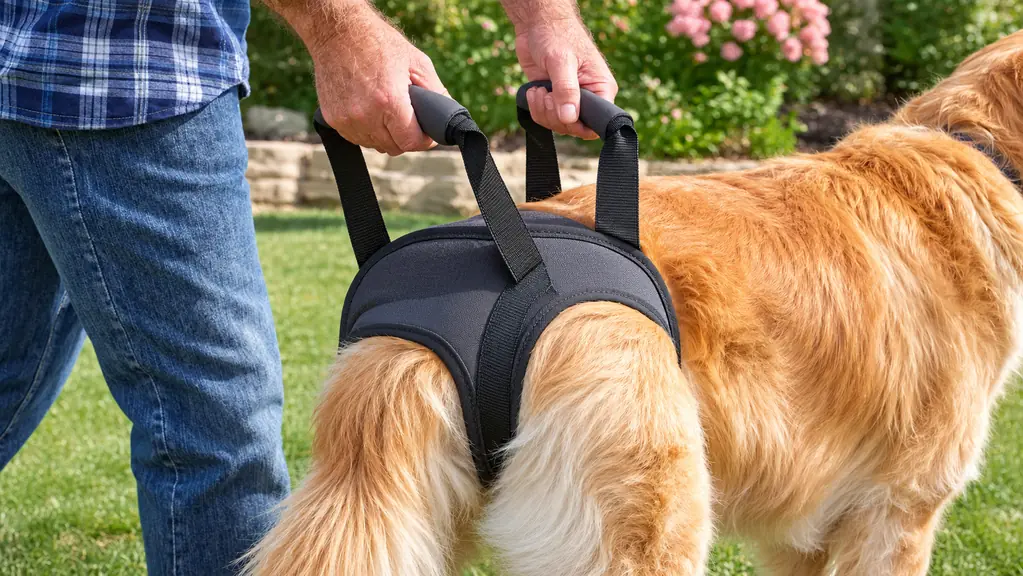
Do not wait until your dog is already struggling at the top of the stairs to figure out the sling. Fit it on a good day, when your dog is standing calmly and you have a few minutes to make adjustments. The LOOBANI sling has adjustable straps on both sides, and getting the length right is the difference between a tool that helps and a tool that fights you.
Stand your dog on a non-slip surface. I used a rubber mat in the kitchen because our tile floors are like an ice rink for Biscuit. Slide the padded part of the sling under his belly, just in front of the back legs, and bring the straps up along each side. The handles should sit high enough that you can stand upright while holding them, not bent over like you are picking up a suitcase.
You want the sling snug enough that it supports weight when you lift, but loose enough that your dog can still walk naturally. I adjusted it so I could slip two fingers between the strap and Biscuit's side. That gave him room to move without the sling riding up into his groin. If you are unsure about the fit, have someone watch your dog walk a few steps and tell you whether the sling stays in place.
Step 2: Teach Your Dog That the Sling Means Walking, Not Being Picked Up
Dogs are smart about tools. The first time Biscuit felt the sling tighten, he stopped dead and looked at me like I had attached a strange new body part. I had to show him that the sling was not a restraint and not a lift. It was just a hand under his belly, the same way I had helped him into the car for years.
Start on flat ground. Put the sling on, hold the handles with light tension, and walk forward slowly. Give your dog a treat every few steps so he associates the pressure with something good. I used small pieces of boiled chicken, and within two sessions Biscuit was walking with the sling like he had worn one his whole life.
The key is to let your dog do the walking. You are not carrying him. You are just there to catch a little weight when a back leg wobbles. If you pull up too hard, your dog will fight the sling. If you let it hang loose, it will drag on the ground. Light, steady tension is the goal, and your dog will quickly learn what that feels like.
Step 3: Use the Sling for the Steps, Not Just the Car
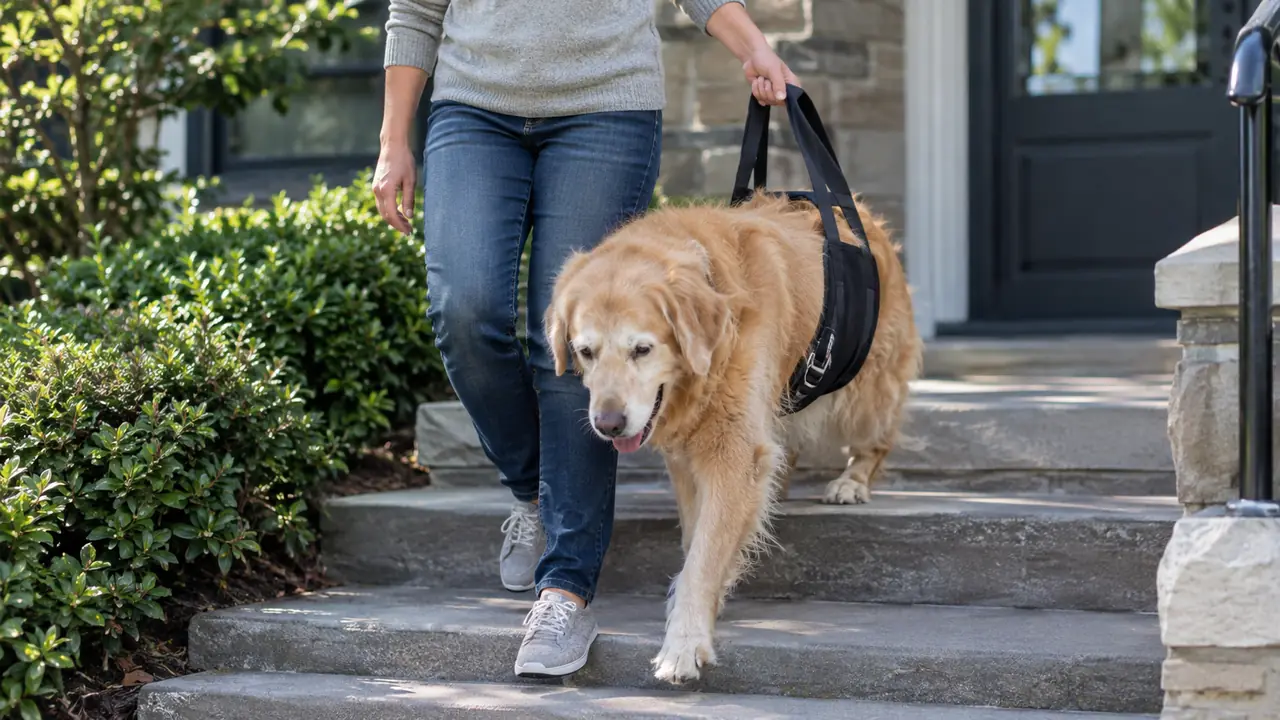
The back steps were Biscuit's biggest fear. Three steps down to the yard, and every one of them felt like a cliff to him when his hips were stiff. The sling changed that. I stood behind him at the top of the steps, held the handles with both hands, and let him set the pace. My job was to take a little weight off his back end so his front legs could do the steering.
Going down, I kept the tension steady and let Biscuit move one step at a time. Going up, I did the same thing from behind, which meant I was walking up the steps backward. It looks a little silly, but it works. The sling caught his weight on the step where his back legs needed the most help, and he stopped hesitating after about a week.
If your dog is nervous on stairs, start with one step. Just one. Let your dog stand at the top, feel the sling support his back end, and take a single step down. Praise him, give him a treat, and go back inside. The next day, try two steps. Building confidence slowly is better than forcing the whole flight at once.
Step 4: Make the Car Routine Predictable
Getting into the SUV was the other trouble spot. The cargo floor is high, and Biscuit used to launch himself up with his back legs. When those legs got weak, he would stand at the bumper with his front paws up and his back end just... waiting. The sling gave me a way to help without grabbing his hips or pulling his tail, which I never liked doing anyway.
I opened the hatch, put the sling on Biscuit, and stood behind him. On the count of three, I lifted with the handles while he pushed with his front legs. The sling took maybe 20 pounds of his weight, which was enough to make the jump feel easy to him. He learned the routine fast: sling on, hatch open, count of three, and he was in the back seat.
The same routine works for getting out of the car, which is actually harder for a dog with weak back legs. Lowering is more controlled than jumping, and the sling lets you slow the descent so your dog lands softly instead of thumping down. I always put a non-slip mat on the cargo floor, too, so Biscuit had solid footing the moment he was inside.
Step 5: Keep the Sling Handy and Check the Fit as Your Dog Changes
The LOOBANI sling lives by our back door now, hanging on a hook next to the leash. That sounds like a small thing, but it matters. If I had to go find it in a closet every time Biscuit needed to go out, I would be tempted to skip it, and skipping it is exactly when a dog takes a bad step and hurts himself.
Check the fit every few weeks. Dogs gain and lose weight, and muscle mass changes as they age. A sling that fit perfectly in January might be too loose by March. The LOOBANI straps are easy to adjust, so it takes about a minute to tighten or loosen them. I also check the padding and stitching regularly, because a worn sling is not worth trusting with 74 pounds of dog.
One more thing: the sling is a support tool, not a treatment. If your dog is limping, in obvious pain, or suddenly unable to use a back leg, that is a conversation for your veterinarian, not a reason to reach for a sling. I saw too many dogs at the clinic whose owners waited weeks before bringing them in. The sling helps with weakness and stiffness. It does not fix an injury.
What Else Helps
The sling was the most useful tool I added, but it was not the only one. I put rubber mats on the tile floors in the hallway and kitchen, which gave Biscuit traction where he used to slide. I trimmed his toenails more often, because long nails make a dog's feet slide even on good flooring. And I started doing a few minutes of gentle stretching with him in the evening, just moving his back legs through a comfortable range of motion while he lay on his side.
I also changed how I fed him. Biscuit is 74 pounds, and carrying extra weight is hard on stiff hips. I talked with his veterinarian about his weight and adjusted his portions, and the difference was noticeable within a few months. Losing even a few pounds takes real load off those back legs. If your dog is carrying extra weight, that conversation with your vet is worth having.
None of this is complicated. It is mostly about paying attention and making small changes around the house. The sling handles the moments where your dog needs a hand, and the rest of it is about giving him a home that is easier to move around in.
The sling took maybe 20 pounds of his weight, which was enough to make the jump feel easy to him.
What I'd Tell You If We Were Sitting at My Kitchen Table
If you are reading this because your dog has started hesitating at the steps, I want you to know that you are not overreacting. That hesitation is your dog telling you something, and the sooner you listen, the easier it is to help. A rear support sling is not a cure for arthritis or hip dysplasia. It is a tool that lets your dog keep living his life while you figure out the bigger picture with your veterinarian.
Start with the sling for the moments that are hard, and use it consistently. Biscuit used it every single time he went down the back steps for the first month, and then we got to a point where he only needed it some of the time. He still has stiff mornings. He still takes a minute to get going. But he does not stand at the top of the steps looking back at me like he is stuck anymore.
The LOOBANI Adjustable Dog Sling for Large Dogs is the one I recommend to friends who are in the same spot, and it is the one I keep hanging by my back door. It is not the cheapest tool you can buy, and it is not the most complicated. It is simply the one that worked for us, and I think it is worth trying for your dog too.
Give Your Dog the Support He Needs Today
The LOOBANI Adjustable Dog Sling for Large Dogs is padded, adjustable, and ready to help with steps, car rides, and wobbly mornings.
Amazon Check Today's Price on Amazon →