
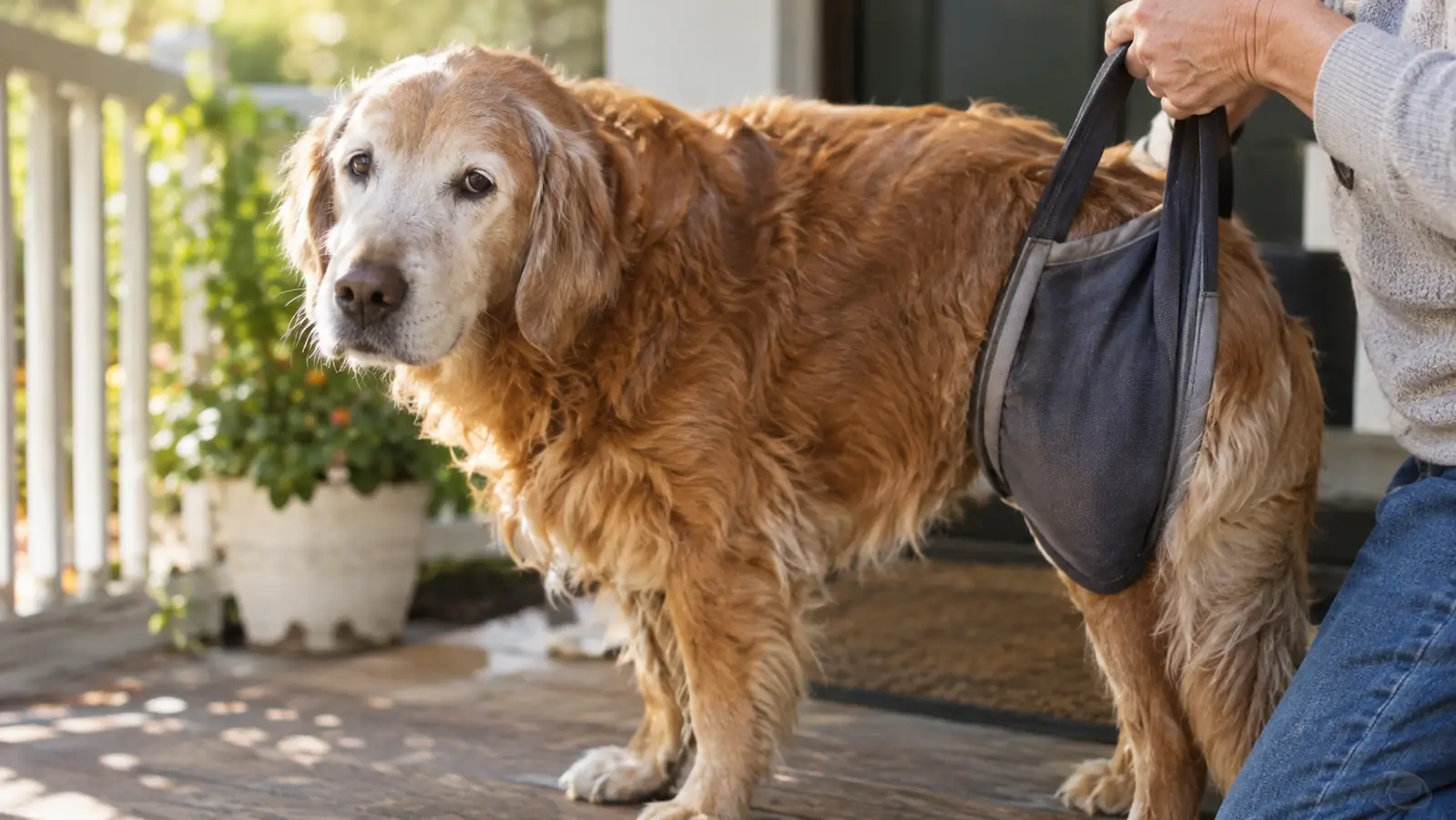
I spent 24 years as a veterinary technician, and I thought I had seen every mobility aid that exists. I had helped owners fit slings, harnesses, ramps, and carts. I had explained the difference between a front lift and a rear lift more times than I can count. Then my own dog Biscuit, an 11-year-old yellow Lab mix who weighs about 74 pounds, started hesitating at the three back steps down to the yard. He would stand at the top, look at the ground, and just wait. That is when I ordered the LOOBANI Rear Support Sling, and that is when I found out how much I did not know about using one in real life.
This is the honest review I wish I had read before I bought it. Not the product page version, not the five-star summary, but the part where I fumbled with the handles, worried I was hurting him, and eventually figured out what this sling is actually good for. If your dog is slowing down on stairs, hesitating at the car, or wobbling on slick floors, this review is for you.
The Quick Verdict
The LOOBANI Rear Support Sling is a genuinely useful tool for a senior dog with mild rear-end weakness, but it is not a hands-free solution and it will not fix the underlying joint problem. It is a lift assist, not a cure, and it works best when you pair it with a floor grip strategy and a conversation with your vet.
Amazon Check Today's Price →The rear support sling that helped my 74-pound Lab mix get down the steps again
After six weeks of daily use, Biscuit went from refusing the back steps to walking them with just a light touch on the handles. If your senior dog is hesitating at stairs or the car, this is the sling I reach for first.
Amazon Check Today's Price on Amazon →How I've Used It
Biscuit's problem started slowly. In early September, I noticed he was taking a beat before jumping into the back of my SUV. By mid-October, he was planting his feet at the top of the three back steps and looking at me like he was waiting for permission. He could still walk on flat ground, but his back hips were stiff, especially first thing in the morning and after a long nap. Our house is a single-story with tile and laminate floors, which might as well be an ice rink for a dog with weak rear legs.
I used the LOOBANI sling twice a day for six weeks. In the morning, I would slide the padded panel under his belly, just in front of his back legs, and lift the handles so the panel cradled his hindquarters. The first time, I made the mistake of lifting too hard. The sling is designed to support, not to hoist, and when I pulled up with both arms, Biscuit's front end stayed planted while his back end came off the floor. He gave me a look that said, 'What are you doing?' I loosened my grip, let him take a step, and realized the trick is to follow his movement, not to lead it.
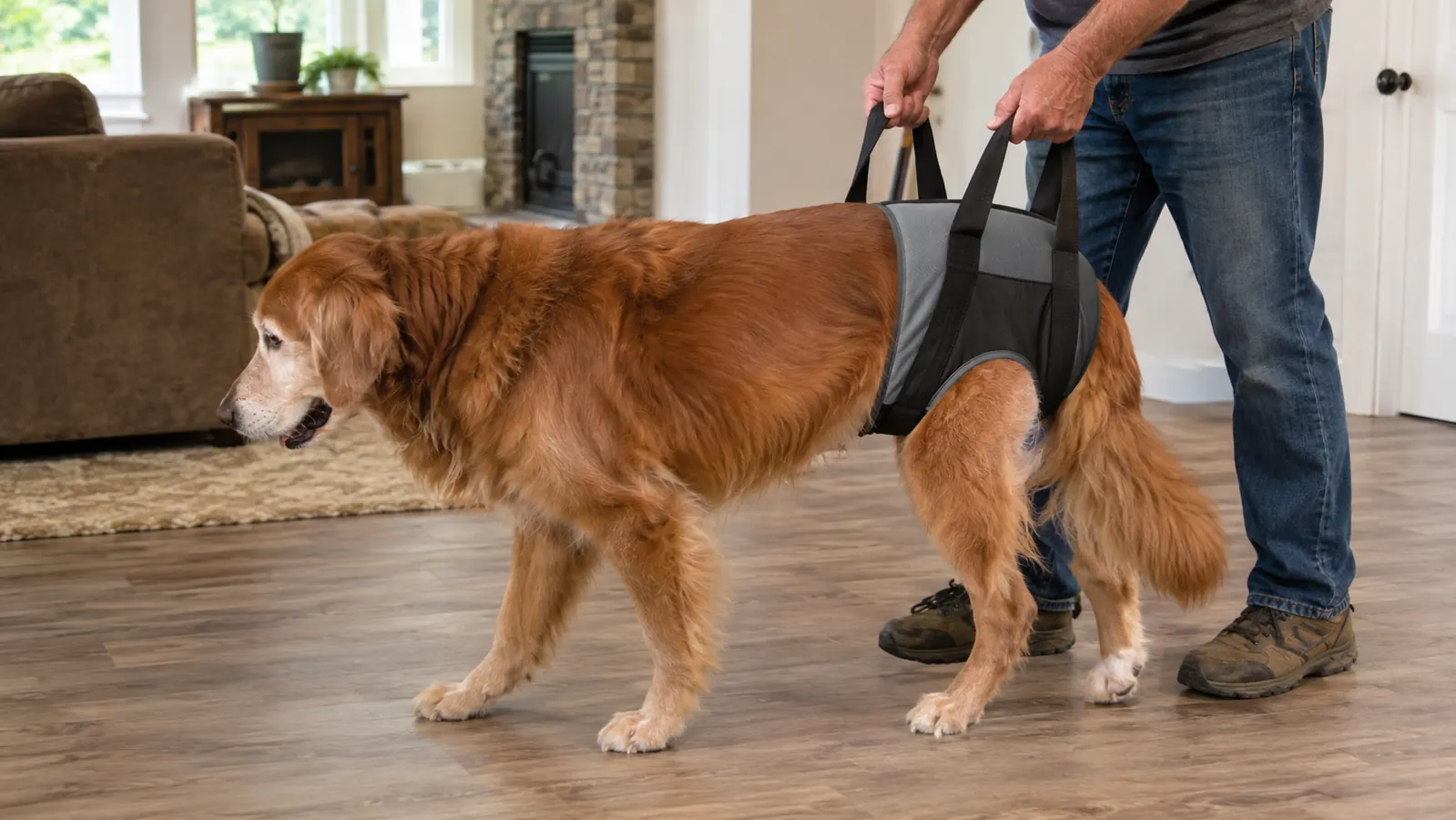
The handles are long enough that I can walk upright while Biscuit walks beside me. That matters more than I expected. With a shorter sling, I would have been bent over at the waist, and after two minutes my lower back would have been screaming. With the LOOBANI, I can take most of his rear-end weight on the handles while he does the actual walking. On the back steps, I stand behind him, hold the handles with my arms nearly straight, and let the sling take maybe 20 percent of his weight. He steps down, I follow. It took us about a week to find a rhythm, and now he actually seems to relax when he feels the panel under him.
The car is where the sling earns its keep. My SUV has a high cargo floor, and Biscuit used to launch himself in with a big front-leg jump. That stopped working around the same time the steps got hard. With the sling, I lift his rear end just enough to get his back feet onto the bumper, then he scrambles the rest of the way. It is not graceful, but it is a lot better than watching him fail three times and then give up.
The routine at the car took some trial and error. What works for us now is this: I open the tailgate, walk Biscuit right up to the bumper in the LOOBANI sling, let him put his front feet up on the cargo floor himself, then lift on both handles as he pushes off with his back legs. He does most of the climbing. I am only covering the part his hips cannot do. Getting out is slower and matters more, because jumping down is hard on stiff joints. I hold the handles and let his back end come down gently. Since we started doing it this way, he has not once slid off the bumper.
What Nobody Tells You About the Fit
The LOOBANI sling is adjustable, and the adjustment is where most of the learning curve lives. The padded panel sits under the belly, and the straps run up between the dog's back legs and over the hips. If the panel is too far forward, it rides up onto the ribcage and does nothing for the rear. If it is too far back, it presses on the genitals and the dog will hate it. Biscuit is 74 pounds, and I found the sweet spot is about two inches in front of his back legs, with the panel centered under his belly. I marked the strap with a piece of tape after the third day so I would not have to re-find it every morning.
The other thing nobody tells you is that the sling only helps if the dog is willing to walk. It does not lift the dog off the ground, and it does not carry the dog. It takes the edge off the rear-end weight so the dog can use the legs it still has. For a dog that is completely non-weight-bearing on a back leg, this sling is not the right tool. You would need a full-body harness or a cart for that. For a dog like Biscuit, who has strength but not confidence, it is exactly right.
I also learned that the sling works better on some surfaces than others. On the laminate floor in our living room, Biscuit's back feet would still slide out from under him even with the sling, because the sling does nothing to add traction. I ended up putting down a few cheap rubber-backed runners along his favorite path, and that combination, sling plus traction, made a much bigger difference than the sling alone. If your dog is slipping on hard floors, do not expect the sling to fix that. Fix the floor first.
The First Week Was Rough
I want to be honest about the first week, because the product photos do not show it. Day one, I put the sling on Biscuit and he immediately sat down. He is a Lab mix, so he is food motivated, and I had a pouch of chicken treats ready, but he still looked at me like I had attached a strange piece of luggage to his back end. I let him wear it for five minutes without walking, just so he could get used to the feeling. Day two, he took two steps with it and then stopped. Day three, he walked the length of the living room. By day seven, he was walking to the back door with the sling on and waiting for me to pick up the handles.
The lesson is that this is a training tool as much as a support tool. Your dog has to learn that the sling means 'I am going to help you, not trap you.' That takes a few sessions. Do not expect to strap it on and go for a walk on the first day. Give your dog time, use high-value treats, and keep the first few sessions short. Biscuit is not a nervous dog, and even he needed about a week to fully accept it.
I also want to mention the handle grip. The handles are padded, which is good, but they are not non-slip. If your hands are sweaty, or if you are wearing sunscreen, the handles can slide a little. I found that a pair of cheap gardening gloves with grippy palms made a big difference on longer walks. It is a small thing, but it is the kind of detail that only shows up after you have actually used the product for a while.
Storage turned out to matter more than I expected, too. For the first week the LOOBANI sling lived in a drawer, and twice I found myself at the back steps with Biscuit already waiting and the sling across the house. Now it hangs on a hook by the back door, and a second sling lives in the SUV, folded under the cargo mat. That way it is always where the hard moment happens. It sounds like a small thing, but a support tool you have to go looking for is one you will skip on a busy morning, and those rushed mornings are exactly when a stiff dog is most likely to slip.
What the Sling Does and Does Not Do
Let me be clear about the medical side, because I am a retired vet tech, not a vet, and I do not want anyone to read this and skip a trip to their own veterinarian. Biscuit has stiff back hips, especially in the morning, and our vet confirmed it is consistent with early arthritis. We did not get a fancy diagnosis, no X-rays, no prescription, because Biscuit is 11 and our vet and I agreed that the treatment would be the same either way: weight management, joint supplements, moderate exercise, and help with the things that are getting hard. The LOOBANI sling is part of that help, but it is not a treatment for arthritis. It does not reduce inflammation, it does not rebuild cartilage, and it does not replace pain medication if your dog needs it.
What it does do is give your dog a few more good months, or years, of doing the things they love. For Biscuit, that means getting down the back steps to sniff the fence line, and getting into the car to go to the park. Those are the moments that matter. The sling is a tool that makes those moments possible, and that is worth a lot, but it is not a cure and I would never pretend it is.
It also changes how you notice things. When you have your hands on the handles twice a day, you feel how much weight your dog is giving you, and that number moves. Some mornings Biscuit barely needs me. Other mornings, especially after a cold night or a long day out, he leans on the sling hard from the first step. I started paying attention to that pattern and mentioning it at his checkups, and his vet found it more useful than my general sense that he was a little stiff lately. A sling will not tell you what is wrong, but it gives you a daily reading you can take to someone who can.
The sling does not fix the hips. It buys your dog a few more good months of doing the things they love, and for us, that has been worth every single walk.

The Pros and Cons After Six Weeks
What I Liked
- Genuinely helps with rear-end support on stairs, curbs, and car entries
- Long handles let you walk upright instead of bending over
- Padded panel is comfortable for the dog once positioned correctly
- Adjustable straps fit a wide range of large dogs
- Easy to clean with a damp cloth
- Light enough to keep in the car for unexpected moments
Where It Falls Short
- Learning curve for positioning the panel correctly
- Does not add traction on slick floors, you still need rugs or booties
- Not suitable for a dog that cannot bear any weight on a back leg
- Handles can slip if your hands are sweaty
- Takes about a week for most dogs to accept it
Who This Is For
The LOOBANI Rear Support Sling is for the owner of a large dog who is starting to slow down. The dog who hesitates at the top of the stairs. The dog who stands at the car and looks at the cargo floor like it is a cliff. The dog who is stiff in the morning but loosens up after a few minutes of walking. If that sounds like your dog, and if your vet has confirmed that the problem is joint stiffness rather than a sudden injury, this sling is worth trying. It is also useful during recovery from a soft-tissue injury or after a procedure, when the dog needs a little help but is expected to regain strength. I have seen slings like this used in the clinic for exactly that purpose.
Who Should Skip It
Skip the LOOBANI sling if your dog cannot bear any weight on a back leg at all. If your dog is dragging a leg, or if the leg is completely non-functional, a sling that goes under the belly will not provide enough support, and you need to talk to your vet about a full-body harness or a cart. Skip it if your dog is small enough that you can just pick them up, because the sling adds more hassle than help. And skip it if you are looking for a hands-free solution. This sling requires you to hold the handles. It is not a wheelchair, and it is not a substitute for a proper rehabilitation plan. If your dog is in obvious pain, or if the weakness came on suddenly, do not order a sling. Call your vet first.
Give your senior dog a few more good walks
Six weeks with the LOOBANI Rear Support Sling gave Biscuit back the back steps and the car rides he was starting to avoid. If your dog is hesitating at stairs or the car, this is the honest, practical tool I recommend.
Amazon Check Today's Price on Amazon →